© Danny Miller
Danny’s DNA Discoveries – Tremellomycetes
(Parasitic Jellies) of the PNW
by Danny Miller
Click here for my Pictorial Key to the Tremellomycetes
|
|
Danny’s DNA Discoveries – Tremellomycetes
(Parasitic Jellies) of the PNW
Click here for my Pictorial Key to the Tremellomycetes |
|
Introduction
Jelly fungi are not brittle at all but gelatinous. It's very hard to tear one and they can't easily be crushed or broken. They are some of the most basal groups of "basidio" fungi, implying that along with crusts, jellies could have been one of the first types of mushroom fruiting bodies to evolve. The two most basal classes of "basidios", the Tremellomycetes and Dacrymycetes, are mostly jellies. The class Agaricomyces contains the "higher" order basidios. Many species in the most basal orders of that class are jellies too (the Auriculariales, Sebacinales and Tremellodendropsidales). Even some Cantharellales, another somewhat basal order, are somewhat gelatinous crusts. Tremellomycetes usually take simple forms like jelly drops on wood or on a host, or of witch's butter (folded jellies on wood). More complicated shapes usually indicate a less basal class than this one. They are also ecologically distinct for being parasitic. When they grow on wood, they often are parasitizing a saprophytic fungus in the wood that may or may not be visible at the time, and if not, they are easily confused with other jelly fungi in the Dacrymycetes and Auriculariales, which are usually saprophytic and not parasitic. When they grow directly on other mushrooms or lichen it is easier to recognize a jelly mushroom as parasitic and therefore in this class. They usually parasitize crust fungi in the Russulales (Peniophora, Stereum, Acanthophysium or Aleurodiscus), Sordariomycete crusts ('asco' flask fungi that are often black, carbonous and pimpled) or lichens, as those crusts were around way back when jellies evolved, but one parasitizes a gilled mushroom. Asexual reproduction is common in this class. Those spores look very different than the sexual spores and the fruiting body may even look different in different stages. I only cover species large enough to see with the naked eye on this page. All jellies are unusual by being one of a few groups of mushrooms called "heterobasidiomycetes", instead of "homobasidiomycetes" (although since "basidiomycete" changed to "basidiomycota" when "basidios" moved from a class to a phylum, I suppose we should be calling them "heterobasidiomycota"). Basidia usually all look the same, and the majority that share that similar look are called "homobasidiomycetes" (homo=same). The few that are different are called "heterobasidiomycetes" (hetero=different). They can differ in several ways: one way is by looking like a tuning fork (Dacrymycetes) and another way is by being transversely septate (horizontal lines - Auriculariales). In this class, the Tremellomycetes, they are longitudinally septate (vertical lines). All jellies have long sterigmata which are the stems that the spores grow on. They are jellies because their basidia are protected in a gel, and they need long sterigmata for them to reach out of the gel and grow the spores. The entire class is well covered in this excellent multi-gene paper by Liu et. al: Towards an integrated phylogenetic classification of the Tremellomycetes. In my ITS-only tree, the genera 'Tremella1', 'Tremella2' and Pseudotremella do not hold together, but this is expected in a single gene tree. abundant common uncommon rare - colour codes match my Pictorial Key and are my opinions and probably reflect my bias of living in W WA. Rare species may be locally common in certain places at certain times. |
|
Tremella s.l. Genetics has split this genus up so it is difficult to know the genus of one of the jellies on this page by sight.
Tremella mesenterica EU - witch's butter. This blob of jelly is somewhat irregular with some to many folds and is usually translucent yellow. It parasitizes species of Peniophora on hardwoods. You won't always get lucky to see them both fruit at the same time, but here you can see both the Peniophora host and the Tremella parasite on the same stick. This sequence from WA matches many EU sequences. Tremella mesenterella BC - very similar, perhaps a little smaller, with rounder spores, usually on dogwood or willow. We do not have DNA of this local species yet, but I am assuming it belongs in Tremella. Tremella globispora UK - colourless to whitish wrinkled blobs (4-5 mm) on the underside on twigs parasitic on Sordariomycetes (flask fungi). Being white, this species resembles 'Tremella1' sp. 'PNW02', below, but we have the type sequence of T. globispora and it is indeed a true Tremella and not that species. We need local collections to prove T. globispora does occur here. Naematelia aurantia EU - usually larger than T. mesenterica with many folds, opaque yellow to orange-yellow. It parasitizes species of Stereum, usually on hardwoods. Once again, you can see both the Stereum host and the Naematelia parasite on the same log here. The similar 'Dacrymyces' chrysospermus grows on conifers with a white point of attachment sometimes visible where it attaches to the wood. Our one somewhat short WA sequence is 3 bp different in ITS1 than sequences found in the EU, ENA and Russia, and they all probably represent this species.
Tremella mesenterica parasite and Peniophora host © Yi-Min Wang, Naematelia aurantia parasite and Stereum host © Yi-Min Wang
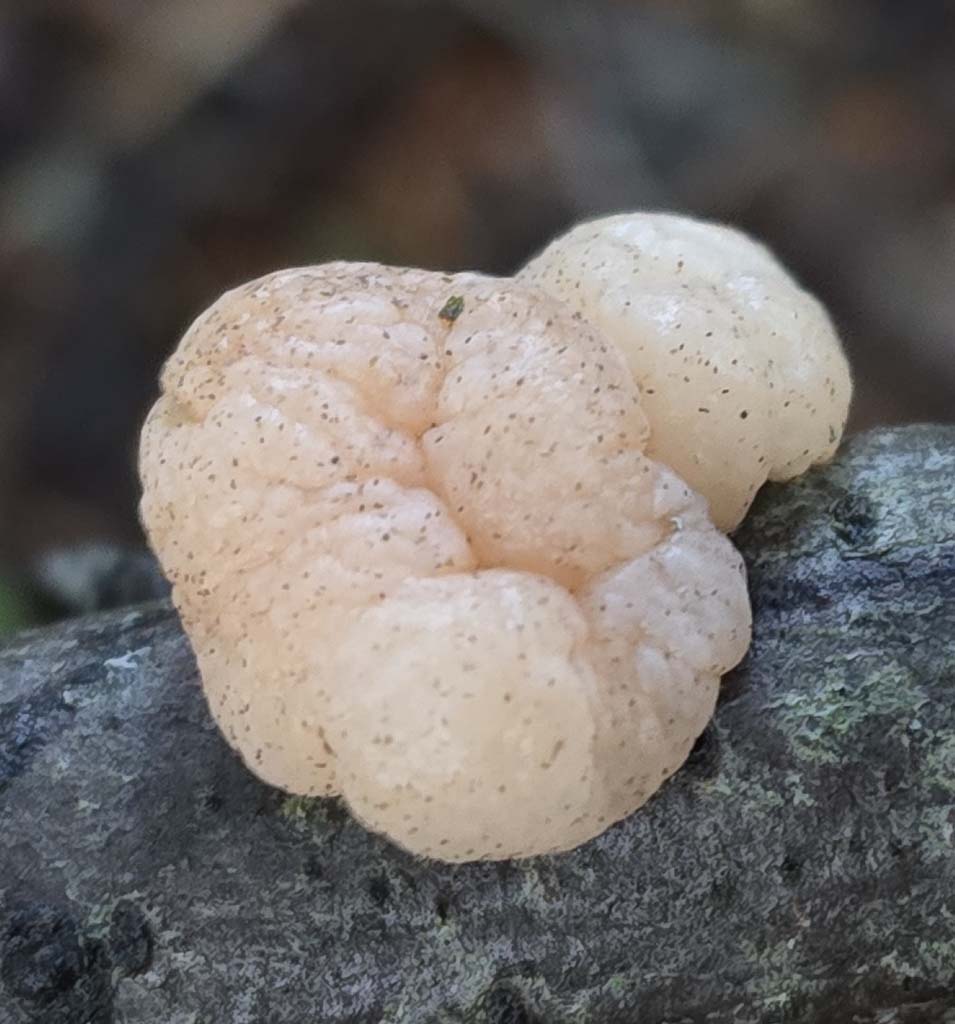
Naematelia encephala EU - found in northern BC and the interior of southern BC. It is a pinkish to yellowish wrinkled brain-like blob, with a hard, white centre. It parasitizes Stereum sanguinolentum, meaning it is found on conifers, unlike most 'Tremella' which usually parasitize hardwood hosts. One collection even yielded sequences of this as well as the Stereum sanguinolentum it was parasitizing! Naematelia sp. 'encephala-BC01' - some BC sequences are distinct. They match a supposed BC type sequence of Tremella indecorata EU, but that might be a mistake as the species was not described from BC, and has been sequenced from the EU and belongs in Pseudotremella.
Naematelia encephala © Leanne Stacy Reitan
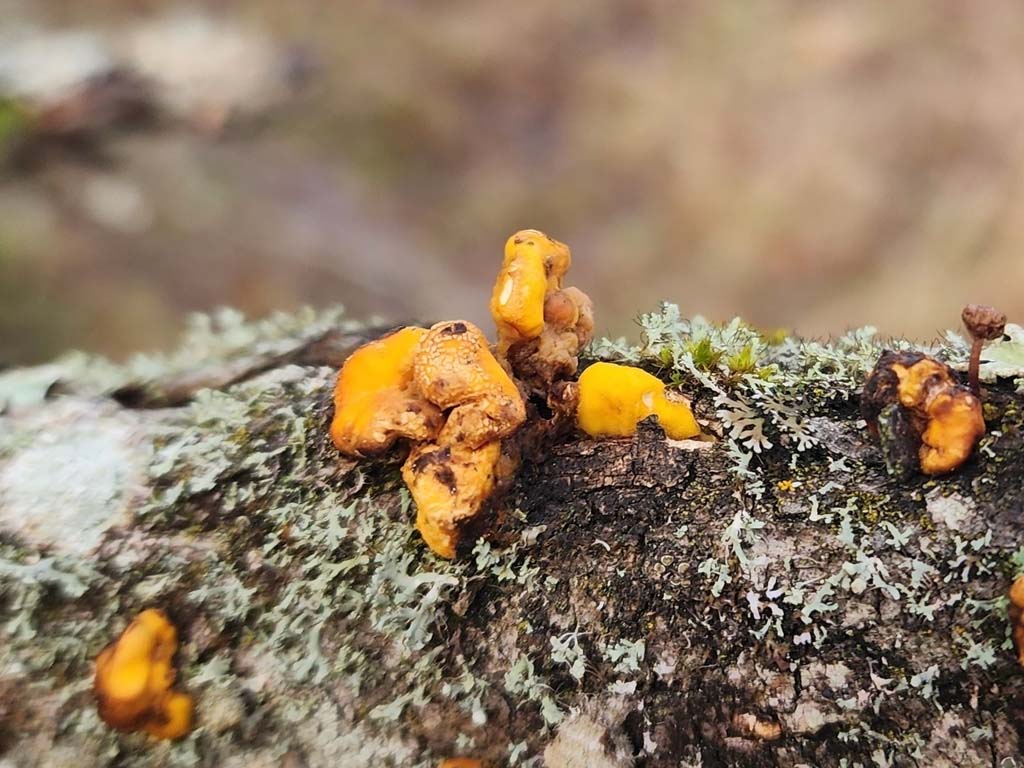
Naematelia sp. 'encephala-CA01' - poorly named because it doesn't resemble N. encephala. They are irregular orange blobs, hard to the touch on oak (that was also covered in lichen), but it is thought to parasitize the Stereum ochraceoflavum whose sequence was also found in the collection so it can probably be found on any wood that species is on.
Naematelia. sp. 'encephala-CA01' © Hannah Burman
Phaeotremella frondosa EU - a very folded caramel brown species, parasitic on Stereum that inhabit hardwoods. One WA sequence matches the type sequence well. Phaeotremella sp. 'frondosa-WA01' - differs in ITS by about 5%. I don't know how to tell it apart from P. frondosa. Phaeotremella foliacea EU - similar, parasitic on Stereum sanguinolentum that inhabit conifers. One OR and one AZ sequence match the type sequence well.
Phaeotremella frondosa © Sharon Squazzo, P. foliacea © Jonathan Frank
Phaeotremella cf mycetophiloides - perhaps described from Japan. Quite different than other Phaeotremella and not easy to recognize to genus. They are minute (~1 mm) clear to pale pink or yellow jellies parasitic on Aleurodiscus (Russulales) crusts on conifers which may darken to a brown colour similar to other Phaeotremella. We have a sequence from the EU purporting to be this, but no clear idea of the type area. This unsequenced photographed collection shows Aleurodiscus on the same stick. We need local sequences.
unsequenced cf Phaeotremella mycetophiloides and possible Aleurodiscus host © Danny Miller
Bulleraceae sp. 'PNW02' - This white species has good support for being inside the unnamed genus Liu calls 'Tremella1'. Sequenced once from OR.
Bulleraceae sp. 'PNW02' © Leah Bendlin
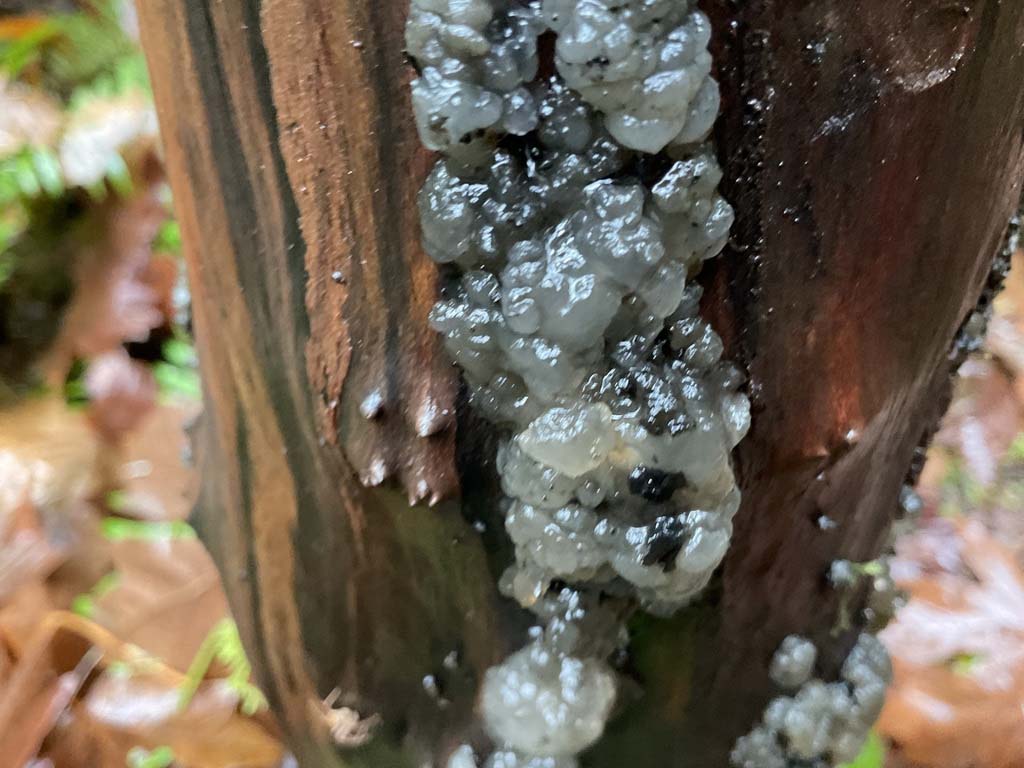
Pseudotremella sp. 'PNW01' - with black pustules growing under the bark and pushing it away. It resembles Pseudotremella moriformis UK, also reported from the PNW. Sequenced once from OR. It should be noted that PNW01 clades with almost 100% support next to both a Liu 'Tremella2' species in the Naemateliaceae family and a Liu Pseudotremella species in the Bulleraceae family. I believe there is some mistake in the data. My ITS tree has strong support for PNW01 being in the Pseudotremella part of the tree, so that is where I am placing this species. Pseudotremella moriformis UK - reddish brown to black tough gelatinous jellies on hardwoods around 1 cm in size, with a hard black core that may be the Sordariomycete host. Liu provides sequences of this but we have no PNW sequences yet to compare. 'Tremella' cf subanomala NC - up to 4 cm cushion shaped colourless then cinnamon then blackish jellies on hardwoods. I don't know the host. As it is described as similar to or the same as Tremella indecorata EU, and that species is either in Pseudotremella or 'Tremella2', depending on which sequence you believe. Liu places the type sequence of T. indecorata in 'Tremella2', but there is a mistake in the data (see PNW01 above) that calls this into question. A sequence of a collection by Bandoni that is probably from BC, purporting to be Tremella subanomala, is inside Pseudotremella. This implies that T. subanomala does occur in the PNW as reported and that it belongs in Pseudotremella. We need east coast type or other reliable sequences and a local photographed sequence to find out for sure. Tremellomycetes sp. 'Tremella2-BC01' - these convoluted black, grey, and white blobs are a species in unnamed genus Tremella2.
Pseudotremella sp. 'PNW01' © Leah Bendlin (2 images), Tremellomycetes sp. 'Tremella2-BC01' © iNaturalist user perki2
Carcinomyces sp. 'PNW01' (C. effibulatus EU misapplied?) - a microscopically thin film covering galls on Gymnopus dryophilus. It would be undetectable to the naked eye if it were not for the galls it causes to grow on the mushroom. It would not be recognizable as being related to these jelly fungi except the galls it creates do happen to be somewhat gelatinous. ENA sequences match EU sequences, but our one unphotographed local sequence so far is unique.
unsequenced Carcinomyces © Buck McAdoo
Other, tiny species reported from the PNW, but without genetic proof yet, with the true genus given: Parasitic on 'asco' flask fungi on wood
Parasitic on 'basidio' crusts on wood
Parasitic on lichens
|