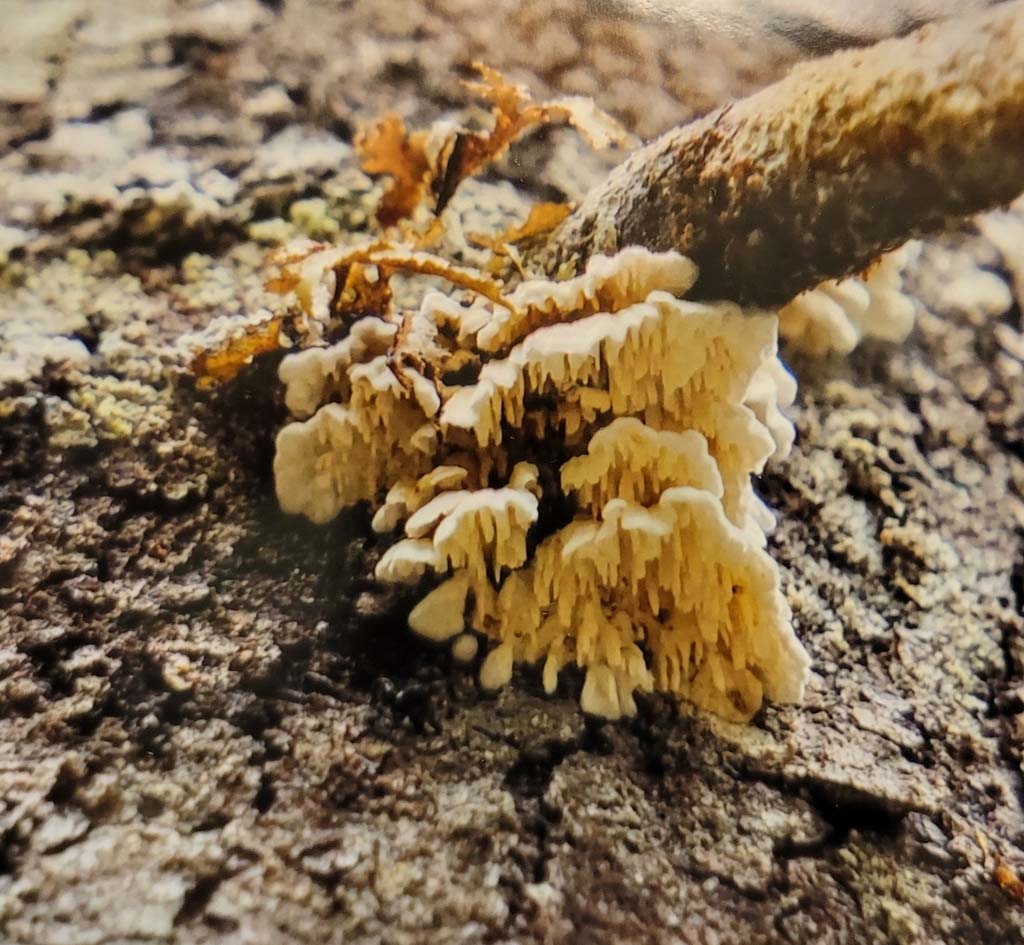
© Christian Schwarz
Danny’s DNA Discoveries – Amylocorticiales (Plicatura) of the PNW
by Danny Miller
|
|
Danny’s DNA Discoveries – Amylocorticiales (Plicatura) of the PNW
|
|
Introduction
The name of this order literally means "amyloid crust", and sure enough they are crust-like with amyloid spores. Most species are the most boring and hard to identify form of all - completely resupinate white crusts. The three most famous and interesting species, covered here, are whitish, bend away from the wood to form caps, and have some interesting folding going on underneath. abundant common uncommon rare - colour codes match my Pictorial Key and are my opinions and probably reflect my bias of living in W WA. Rare species may be locally common in certain places at certain times. |
|
Plicatura Plicatura nivea EU - whitish (can stain blue) thin, soft and finely velvety fruitbody that is faintly zoned and bent away from the surface of the wood (effuso-reflexed), white underneath with unique, interesting "tuberculate-plicate" folds somewhere between wrinkles and teeth, that are often just gentle wrinkles. AK sequences only differs by a couple of bp from EU sequences, and BC and WA sequences differ by a couple more from AK, but I believe it all to be the same species. Plicatura crispa EU (=Plicaturopsis crispa) - cap can be darker orange-brown and it is attached almost at a single point with not as much of it lying against the wood. Underneath there are almost gills, but they are wrinkly and veiny. It is a fairly close sister species of P. nivea, within the 3% that sometimes indicates being the same species, never mind genus. So it has been decided that it does not need its own genus, Plicaturopsis, in which some have placed it. ENA and EU DNA are the same, matching BC and WA sequences. Plicatura sp. 'BC01' (Irpicodon pendulus EU misapplied) - with hanging (pendulus) pseudo gill-like protrusions. Local sequences differ by at least 3% in ITS from EU type area sequences of Plicatura pendula. It was recently decided to place the species inside Plicatura instead of consider it its own genus, Irpicodon, sister to Plicatura. Found in BC.
Plicatura nivea © Yi-Min Wang
unsequenced Plicatura crispa © Christian Schwarz
Plicatura sp. 'BC01' © Kendra Dedinsky |