© Matt Trappe

Back to Main Menu

Danny’s DNA Discoveries – Eurotiomycetes of the PNW
by Danny Miller

Introduction

This class is best known for deer truffles and earth tongues on animal remains. Most of what we know about Elaphomyces (and in fact most truffle groups) in the PNW is thanks to Heather Dawson and her dog Rye.

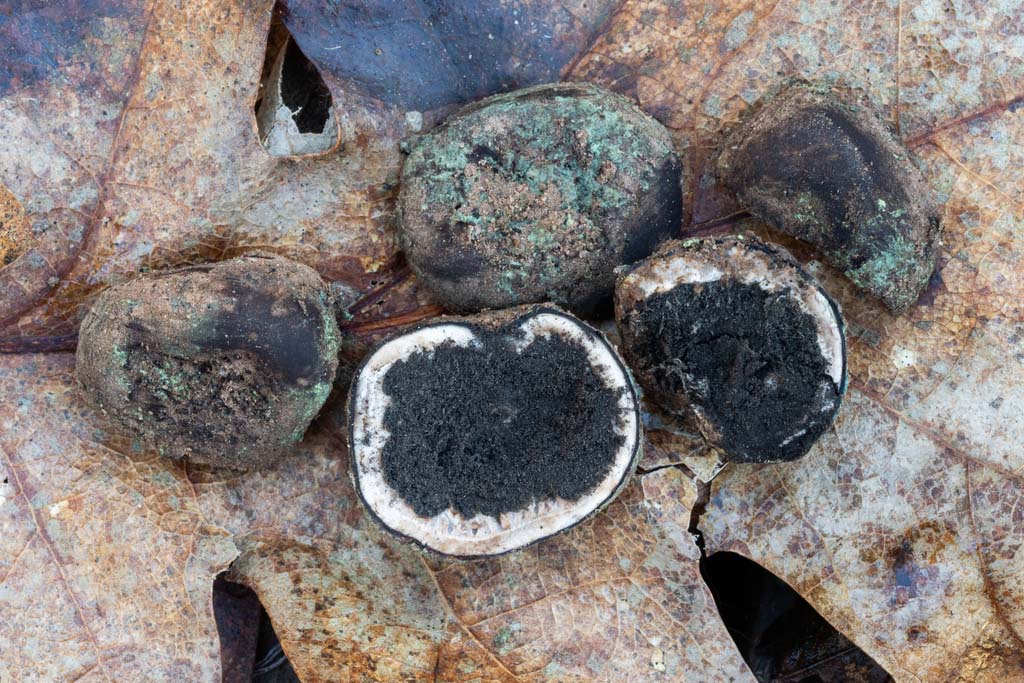
Deer truffles (Elaphomyces) - have a think, warty rind and a cottony/powdery white interior that quickly turns black.

Onygena - earth tongues (spherical powdery tan heads with long stems) on animal remains.

Arthroderma - whitish irregular spheres on animal remains/dung but without stems.

Chaenothecopsis and Sorocybe - small black, round headed clubs on tree resin.

Penicillium (used to make some cheeses and penicillin) and Aspergillus (used to make sake) are in this class.

abundant common uncommon rare - colour codes match my Pictorial Key and are my opinions and probably reflect my bias of living in W WA. Rare species may be locally common in certain places at certain times.

Eurotiomycetes

Elaphomyces - deer truffles

Reticulated rind

Elaphomyces cf muricatus EU - described as having a pale inner peridium marbled with darker circular dots. We have reliable EU sequences but so far only a single OR collection matches. Most turn out to be 'americanus-PNW07', described below.

Elaphomyces muricatus EU var. reticulatus EU - supposedly differs by having subtler warting on the exterior and subtler marbling inside the peridium. We have the EU type sequence, and it is 2-3 bp different than that of the type variety. It has been reported from here, but no verification yet.

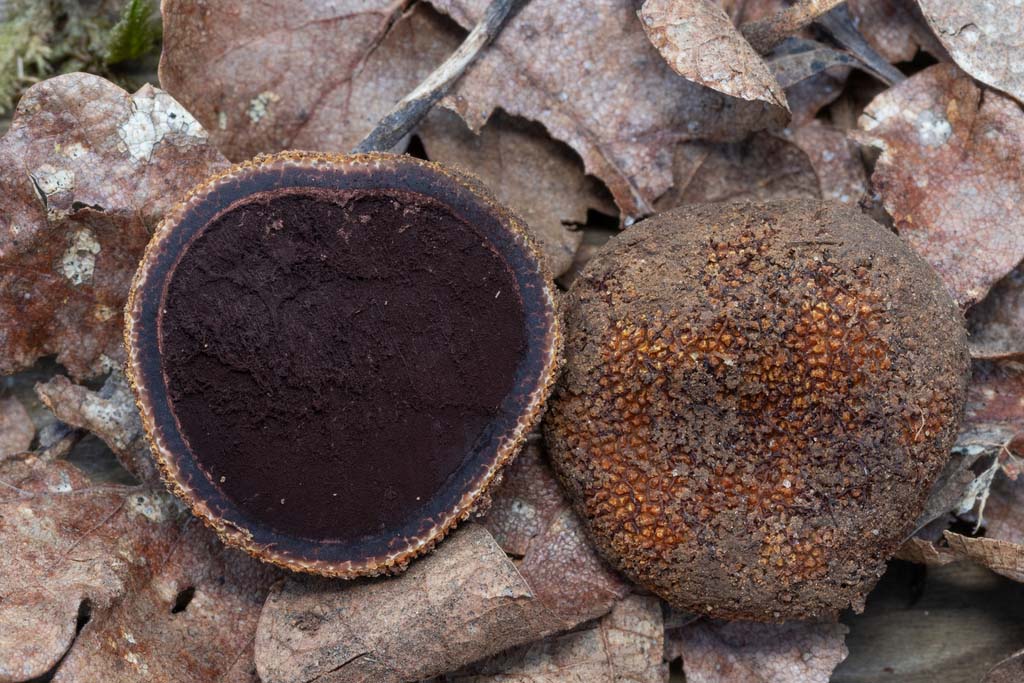
Elaphomyces sp. 'americanus-PNW07' - more common than E. muricatus, closely related, with a similar marbling pattern (dark dots on a pale background). Most local sequences of collections with peridium reticulation so far have turned out to be closer to Elaphomyces americanus WV than to E. muricatus EU.

Elaphomyces sp. 'barrioi-PNW02' - the E. barrioi complex has a marbling pattern that can look the opposite, as if purple-black is the background colour with pale veins, although E. barrioi itself is said to be marbled with pale dots, not pale veins. The photos demonstrate the difference, but it seems variable and subjective. Paz's 'aff barrioi 1', sister to E. barrioi EU, known from OR.

Elaphomyces sp. 'barrioi-PNW03' - Paz's 'aff barrioi 2', sister to E. barrioi EU, presumably from OR, this is a single unverified sequence.

Elaphomyces sp. 'barrioi-PNW04' - sister to E. barrioi EU, knownn from OR.

Elaphomyces sp. 'barrioi-PNW05' - sister to E. barrioi EU, known from OR.

Elaphomyces sp. 'decipiens-PNW06' - one OR sequence differs by 4-5 bp from the EU holotype sequence, and LSU differs by 3 bp as well. That seems enough to justify a codename. E. decipiens is known for a purple-brown inner peridium marbled with pale veins, similar to what is found in our species in the E. barrioi complex.

Covered in copious yellowish mycelium

Elaphomyces citrinus EU - easily recognized by being covered in copious yellowish mycelium. Known from 2 OR collections.

Exterior a warm yellow- or orange-brown, inner peridium white

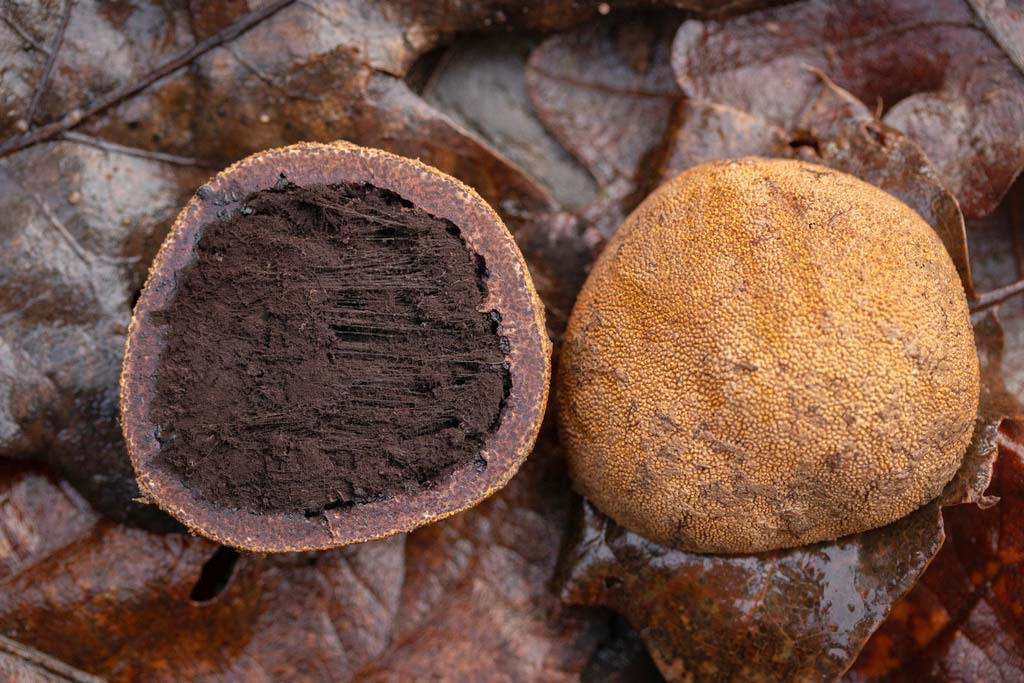
Elaphomyces borealis EU - described with pale orange tones in the inner peridium. The type sequence is very close to the type sequence of E. asperulus EU (2 bp different), which is said to lack the orange tones, but our sequences better match E. borealis and usually do show the orange tones. One environmental sequence that might be from somewhere in BC better matches E. asperulus, but I haven't seen any fruiting bodies yet.

Elaphomyces sp. 'PNW01' -very similar

Elaphomyces granulatus EU - we have the EU type sequence and it has been reported from here as our most common deer truffle, but never verified, so that's suspicious. I suspect reports of this were its closest relatives, E. borealis and PNW01.

Elaphomyces subviscidus OR - the smooth exterior is a paler yellow-brown than the others. Some modern collections match an old collection and show us what this probably is. To some, it has a unique odor of paint.

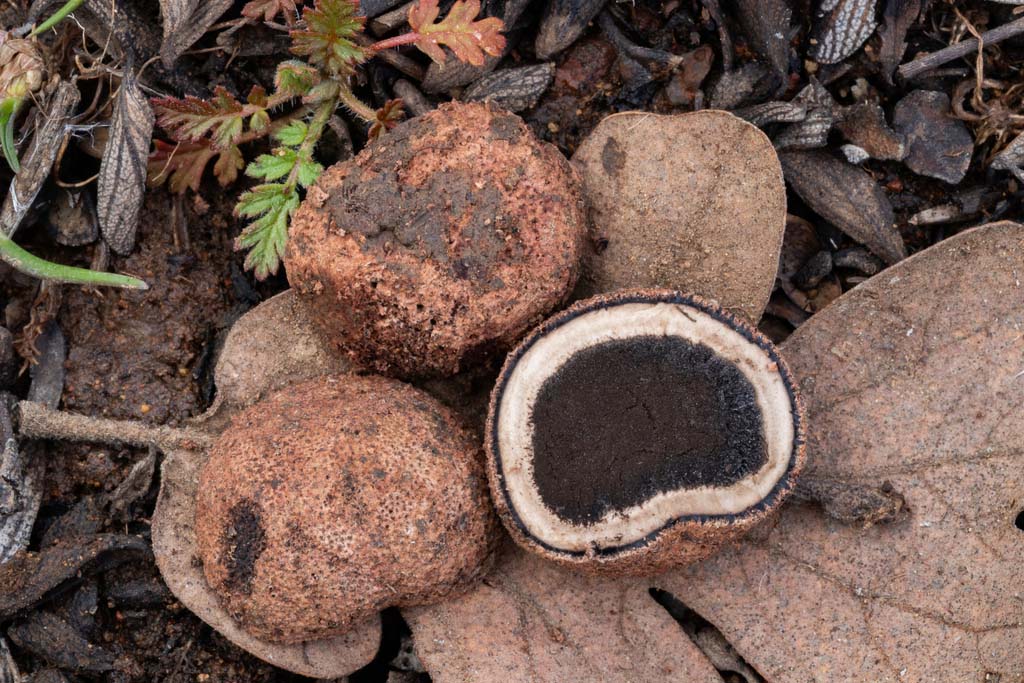
Elaphomyces sp. 'PNW11' - reddish/vinaceous warty exterior. One OR collection is close to Elaphomyces aculeatus EU.

Exterior a warm yellow- or orange-brown, inner peridium turns bluish-grey

Elaphomyces papillatus EU -

Exterior a darker, colder brown, covered in greenish mycelium

Elaphomyces maculatus EU - one OR collection matches the epitype sequence very well.

Exterior a smoothish, dark, colder brown

Elaphomyces sp. 'PNW08' -close to Elaphomyces spirosporus EU.

Elaphomyces anthracinus EU - reported from here, but not yet proven. The closely related PNW09 may be what we were finding instead.

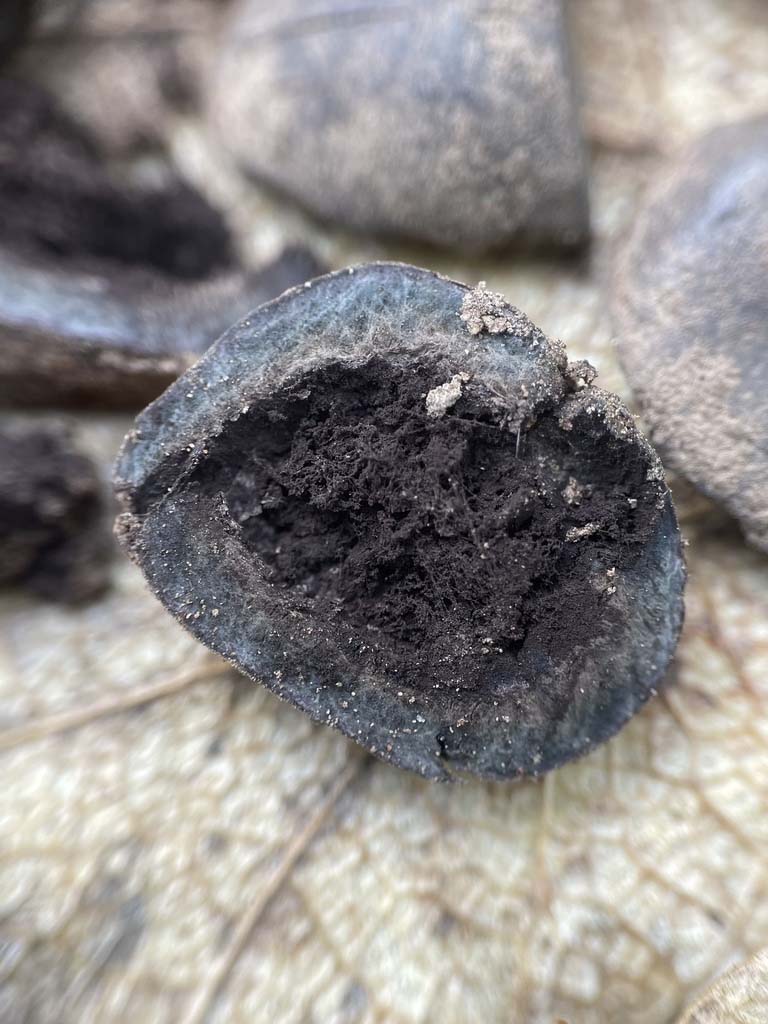
Elaphomyces sp. 'PNW09' - close to Elaphomyces anthrancinus EU, and this may be what reports of E. anthracinus were. Jim Trappe suspected that our local species might be distinct.

Elaphomyces sp. 'PNW9a' - two collections differ in what are usually insignificant indels of repeated patterns, but mysteriously, they differ in the same way.

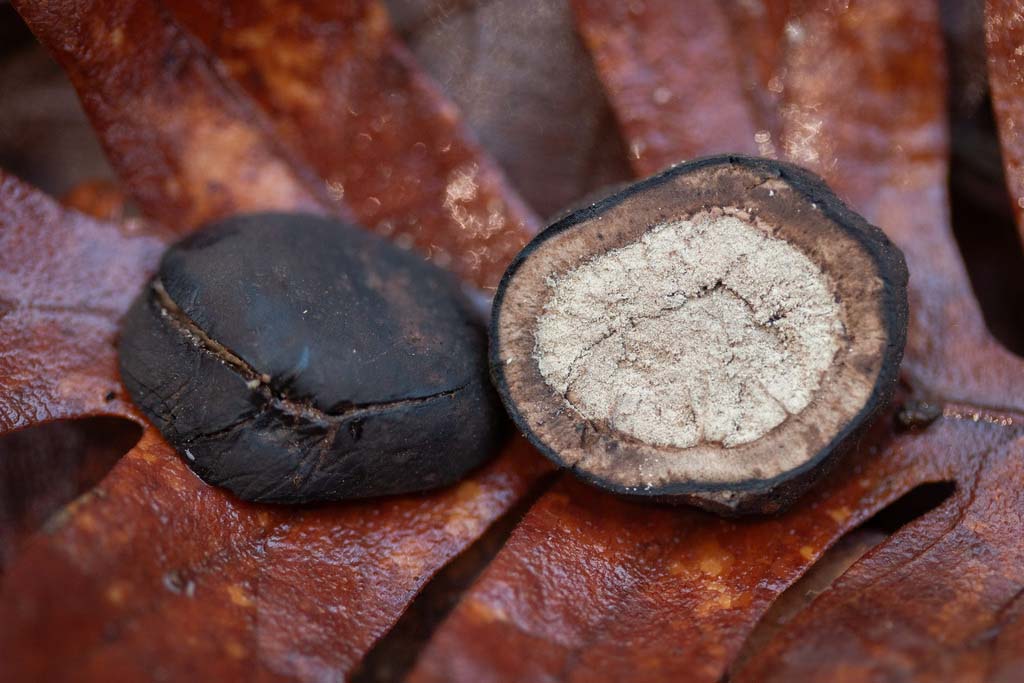
Elaphomyces sp. 'PNW10' - one WA collection with an almost black exterior.

Elaphomyces sp. 'americanus-PNW07' and 'barrioi-PNW04' © Heather Dawson, showing the different reticulation patterns,     E. citrinus © Heather Dawson

Elaphomyces borealis © Noah Siegel and Heather Dawson,     E. PNW01 and E. subviscidus © Heather Dawson


Elaphymyces PNW11, E. papillatus, and E. maculatus © Heather Dawson

Elaphymyces PNW09 and PNW10 © Heather Dawson


Onygena corvina EU - earth tongues (spherical powdery tan heads with long stems) on animal fur and dung. We only have type sequences of LSU, but read on.

Onygena cf equina EU - similar, on animal horns and hooves. We have an LSU type sequence, and a reliable ITS sequence and it turns out it has the same ITS as O. corvina.

Arthroderma silverae EU - irregular white spheres on bones inside coyote dung. Not reported here before it was found and sequenced and matched what I think is the type sequence.

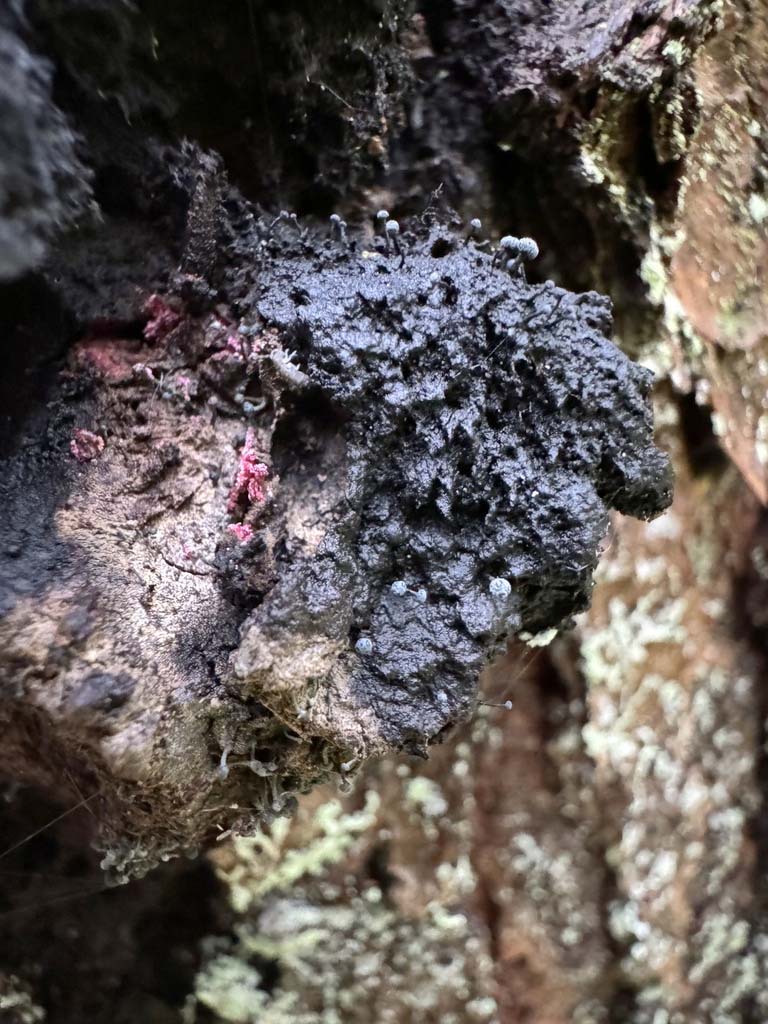
Sorocybe sp. 'WA01' - close to Sorocybe resinae EU, the sexual stage of this appears to be tiny mottled black balls on stems growing on conifer resin. Although accepted in the Eurotiomycetes, the placement is unclear. In 2007 it was placed in the Chaetothyriales order of the Dothideomycetes, and their and my tree shows the placement leaning more towards the Dothideomycetes than the Eurotiomycetes, but the Chaetothyriales are now accepted in the Eurotiomycetes.

Chaenothecopsis nigripunctata OR - similar to Sorocybe. The correct genus for this needs to be verified.

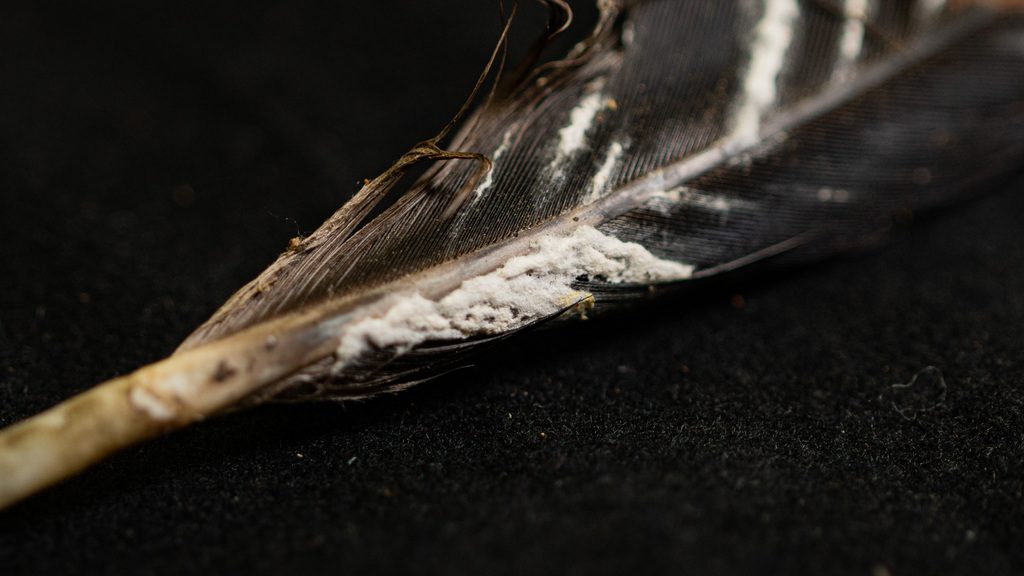
Onygenales sp. 'WA01' - a cobwebby, powdery white covering on feathers. It is close to the genus Guarromyces.

Onygena corvina, Arthroderma silverae, and Sorocybe sp. 'WA01' © Matthew Koons,     Chaenothecopsis nigripunctata © Maurissa Dorn

Onygenales sp. 'WA01' © Tyler Brunner

Back to Main Menu