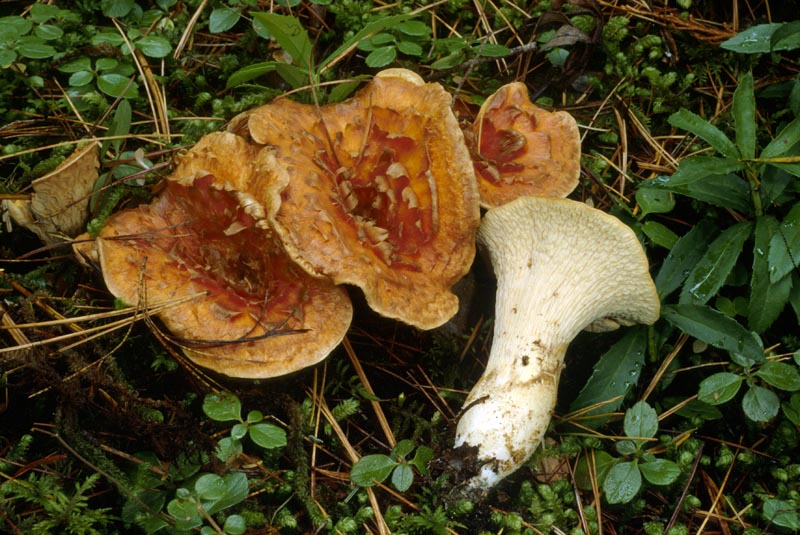
© Michael Beug
Danny’s DNA Discoveries – Gomphus and
Turbinellus of the PNW
by Danny Miller
Click here for my Pictorial Key to Gomphus and Turbinellus.
|
|
Danny’s DNA Discoveries – Gomphus and
Turbinellus of the PNW
Click here for my Pictorial Key to Gomphus and Turbinellus. |
|
Introduction
Gomphus and Turbinellus - false chanterelles with a veined stem (a busier pattern than the parallel ridges of true chanterelles). Gautieria, Protogautieria and Destuntzia - false truffles with a thin skin that wears away allowing you to see into some of the hollow chambers inside. The texture is enough like rubber that some fresh specimens might even bounce. Ramaria - corals covered on their own page. Unfortunately Ramaria subgenus Ramaria and Ramaria subgenus Laeticolor are in one big clade with Gomphus, Turbinellus, and Gautieria, etc. This means that either false chanterelles and corals will all be in one large genus Gomphus (the oldest name), or Ramaria subgenus Laeticolor may have to be split into a bunch of cryptic genera (my first guess is 9 genera)! Neither is an ideal solution. It is fascinating to have learned that false chanterelles and corals evolved back and forth so many times. I can't figure out how. It's easier to see how gilled and pored mushrooms evolved back and forth, you can picture pores as gills that are pinched together every once in a while to form the pores. But I cannot fathom why the two very different shapes of Gomphus/Turbinellus and Ramaria evolved back and forth so many times. See this tree. abundant common uncommon rare - colour codes match my Pictorial Key and are my opinions and probably reflect my bias of living in W WA. Rare species may be locally common in certain places at certain times. |
|
Summary of Interesting Results
Here are some of the newest, most interesting results of the study:
|
|
Gautieria, Protogautieria and
Destuntzia These are the false truffles from this family. Gautieria have thin skin that wears away allowing you to see into some of the hollow chambers inside. The texture is enough like rubber that some fresh specimens might even bounce. Some are odorless but some smell somewhat nauseating. Gautieria - we have data for 24 putative genetic species so far.
Gomphus and Turbinellus False chanterelles with a veined stem (a busier pattern than the parallel ridges of true chanterelles).
Gomphus sp. 'PNW01' (Gomphus clavatus EU misapplied) - has a purple stem with a more drab, smooth cap. Our species is about 3% different in ITS from EU sequences, so it might need a new name. Cantharellus brevipes is an east coast species thought to be synonymous, but we need east coast sequences to see if ours is the same as theirs and can share a new name. Gomphus brevipes is available as a name, if so. Whatever it is, this seems to be the common coastal species out west, with large spores similar in size to G. clavatus, up to 15 x 7u. Gomphus sp. 'PNW02' - some sequences are unique and represent a previously unknown second species in the group, with smaller spores (averaging 10.5 x 5u).
Gomphus sp. 'PNW01' © Alan Rockefeller (from CA), G. sp. 'PNW02' © Kaitlyn Labertew
Turbinellus floccosus group We do not know what Turbinellus floccosus PA is. We need a type sequence. It could be one of the below species. 'Cantharellus' floccosus forma rainierensis WA (formerly 'floccosus-PNW01') - orange, with a indented cap with flattened scales. The orange may fade to brown. A neotype was designated from OR, not the same state as the holotype (WA). Assuming that's allowed, we have the neotype sequence and a bunch of matching local collections. Turbinellus sp. 'CA02' - old CA herbarium sequences of 'Gomphus' bonarii CA don't agree on what that is; some are T. sp. 'CA01' and others are just T. floccosus, neither of which seem correct. We need a type sequence; perhaps it is this. It is smaller, clustered, paler (yellow on the stem), with more erect scales and often partially buried. This could be 'Cantharellus' floccosus var. wilsonii CA or one of the many other varieties and forms of T. floccosus. We have no idea which, if any, are genetically distinct. Turbinellus sp. 'floccosus-CA01' (=Gomphus bonarii forma novamexicanus NM) - from ID, CA, and AZ. This orange species has few, erect scales like G. bonarii, but without the yellow on the stem. It matches the holotype sequence of G. bonarii forma novamexicanus NM. Turbinellus sp. 'PNW03' - matches a 1947 CA sequence identified as Cantharellus floccosus forma rainierensis, but that was misidentified as it does not match the neotype sequence. 'Gomphus' bonarii CA - this similar southern species is smaller, clustered, paler (yellow on the stem), with more erect scales and often partially buried. Various old CA herbarium specimens labeled G. bonarii turned out to be either T. sp. 'CA01' or T. floccosus, but neither seem right. Old collections of Gomphus bonarii f0rma wilsonii CA also were either T. sp. 'CA01' or T. floccosus. Whatever it is, it has been reported from the PNW.
Turbinellus kauffmanii group Turbinellus kaufmannii WA (formerly 'floccosus-BC01') - interestingly, the real thing is rarer than the unnamed species, known from one BC collection and a soil sample. Turbinellus sp. 'PNW02' WA - this local species has dull brown colours even when fresh (never orange nor yellow), and thicker, more erect scales like G. bonarii. Turbinellus sp. 'CA01' - found in BC and CA. Some old CA herbarium sequences of 'Gomphus' bonarii CA matched this.
unsequenced Turbinellus cf floccosus © Steve Trudell, Turbinellus sp. 'CA02' © Shannon Adams, Turbinellus sp. 'floccosus-CA01' © Ed Barge |