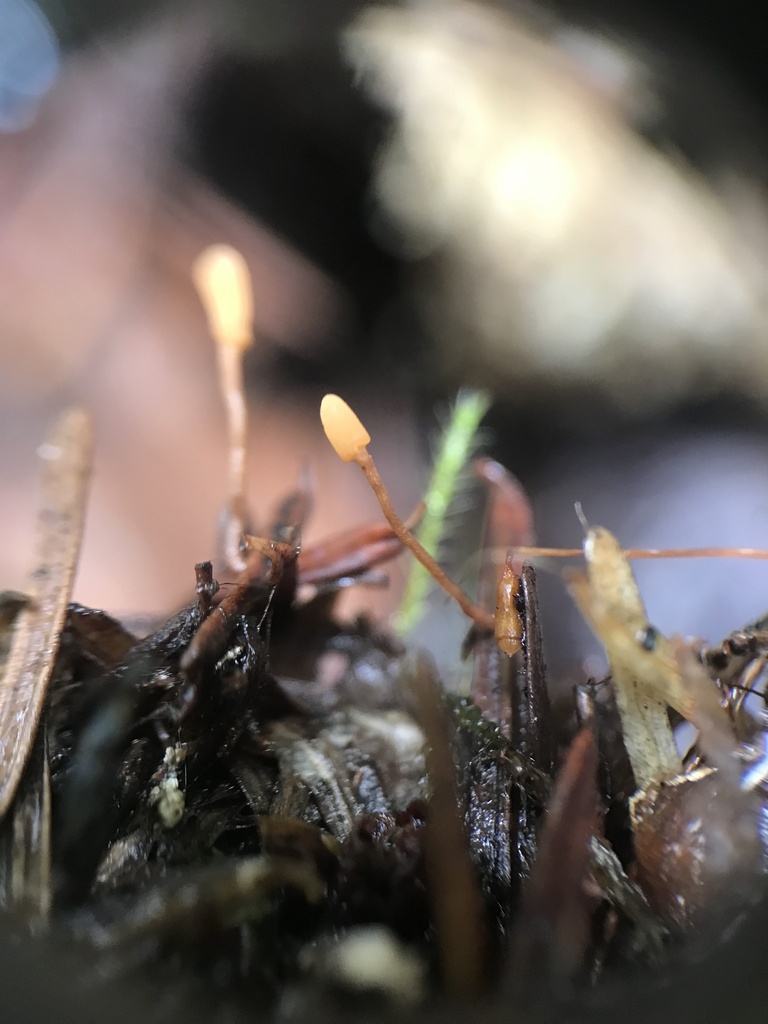
© Mandy Hackney
Danny’s DNA Discoveries – 'Sclerotiniales' of the PNW
by Danny Miller
|
|
Danny’s DNA Discoveries – 'Sclerotiniales' of the PNW
|
|
Introduction
The Leotiomycetes are the inoperculate class of ascos, where the ascii do not have a lid, but instead have a pore at the top that the spores escape from. This is difficult to see without a quality microscope, but the species in the class are usually tiny cup fungi (maximum size <1cm across) growing on wood, as well as the earth tongues (club fungi with a differentiated head). In contrast, the Pezizomycetes contain true truffles, morels and false morels, the larger cup fungi, and tiny cups that do not grow on wood (although there are exceptions). Other smaller classes of ascos exist as well, with more cups, truffle-like fungi, and carbonaceous fungi. My ITS tree cannot always show the families holding together, but a 15-gene study and this previous 15-gene study confirm much of where I have placed these species. This page contains Cenangiaceae, Chlorociboriaceae, Cordieritidaceae, Rutstroemiaceae, and Sclerotiniaceae, the families at the base of the very large Helotiales tree, once considered to be split into separate orders. It contains a diverse array of mushrooms. Even though they will likely always remain part of the larger order Helotiales, I deal with them separately because there are too many species for one page. I also split out the Dermateaceae family. abundant common uncommon rare - colour codes match my Pictorial Key and are my opinions and probably reflect my bias of living in W WA. Rare species may be locally common in certain places at certain times. |
|
Chlorociboriaceae Tiny blue cups on wood! The mycelium in the wood can turn the wood itself blue!
Chlorociboria aeruginascens EU - the cups have an irregular, wavy margin. Also, the cups grow up to 7mm across, the stems are often off-centre, several cups might arise from the same dark mass, and the interior flesh is blue. Chlorociboria aeruginosa EU - are usually perfectly round caps. Also, the cups usually only grow to 5mm across, the stems are usually central, the cups rise invididually from the wood, and the interior flesh may have an orange tinge. Chlorociboria sp. 'PNW01' - one OR sequence is clearly corrupted but seems to indicate a third species might be here as portions of it are closer to other species then they are our known species.
Chlorociboria aeruginascens © Mandy Hackney (from CA), C. aeruginosa © iNaturalist user adisadeh (from CA) |
|
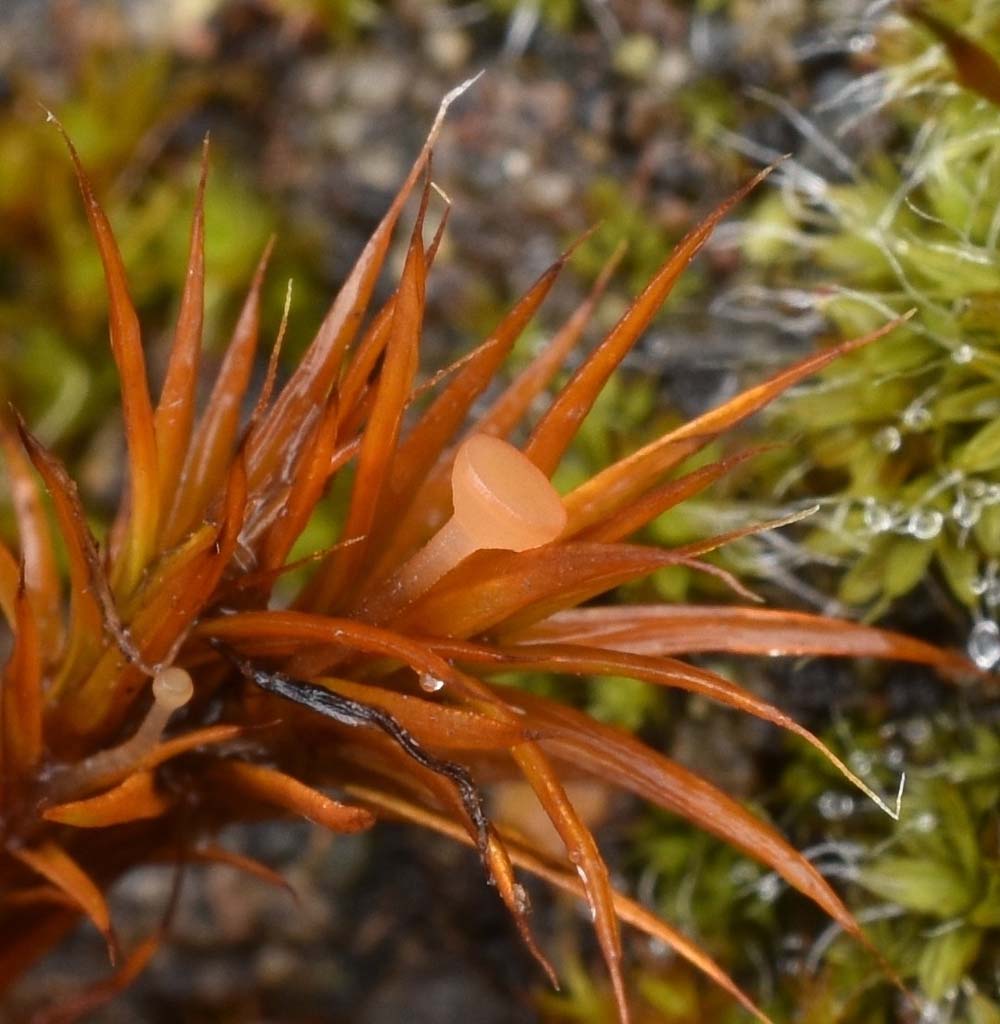
Sclerotiniaceae This is a family of parasites. It would be nice to keep thinking of it as its own family, since these parasites clade nicely together here, but since this family lives paraphyletic inside the Rutstroemiaceae family, that family would have to be split up awkwardly (into at least 2 but maybe four or more families) if you don't allow a family to live inside another family. The limits around the genera Botrytis, Ciboria, Sclerotinia, Ciborina, Monilinia, Myriosclerotinia, Ovulina, and Sclerencoelia are confusing since there are very few differences in ITS between them. This family needs work. Botrytis is the oldest asexual (anamorph) genus. Ciboria and Sclerotinia are tied for the oldest sexual (teleomorph) genus. Since the family is the Sclerotiniaceae, perhaps Sclerotinia is an appropriate genus for them all to be absorbed into. Or perhaps they will stay separate genera, setting a record for how little ITS difference can constitute distinct genera. We shall see. Botrytis cinerea EU - an asexual mold that causes noble rot of grapes that can make interesting wines. We have worldwide sequences. Ciboria amentacea EU? - what I think are type area sequences show us what this is, and it does not appear to be in Ciboria s.s. We need local collections. Ciboria caucus EU - the type species of the genus that shows us what true Ciboria are. We need local collections. Ciboria sp. 'BC01' - one BC collection is close to C. caucus, the type of the genus, and may be in Ciboria s.s. Ciboria gordonii BC - no DNA yet, so I don't know the true genus. Ciboria seminicola OR - no DNA yet, so I don't know the true genus. Ciborinia whetzelii NY - we don't have a sequence of the type species to know if this is the correct genus. We need local collections. Monilinia demissa ENA? - no DNA, so I don't know the true genus. We need local collections. Monilinia fructicola PA - type of genus. We need local collections. Monilinia gregaria WA - no DNA yet, so I don't know the true genus. Monilinia laxa EU - an OR and BC sequence match worldwide sequences. We need local photos. Myriosclerotinia caricis-ampullaceae EU - OR and ID sequences match a sequence that might be from the EU and show us what this species is. Myriosclerotinia curreyana UK - I think we have a type area sequence of this. We need local collections. Myriosclerotinia duriaeana EU - I think we have a type area sequence of this. We need local collections. Ovulinia perplexa WA - no DNA, so I can't confirm the genus, but we have sequence of the type species. We need local collections. Sclerencoelia pruinosa CO (=Encoelia pruinosa) - doesn't clade with the type species, may need a new genus. We need local collections. Sclerotinia sclerotiorum EU - local sequences match many worldwide sequences of the type of the genus, but no photos yet. Sclerotina juncigena WA -no DNA yet to confirm the genus. We need local collections. Sclerotiniaceae sp. 'PNW04' - long stemmed, in fen. Sclerotia submerged in wet moss/peat/decayed sedges. Spores 12.5 - 15 x 6.5 - 8. Ascus apical pore IKI+. Possibly in or near the genus Sclerotinia. Sclerotiniaceae sp. 'PNW05' - collections from OR and CA. Sclerotiniaceae sp. 'PNW06' - one OR collection. 'Ciboria' viridifusca EU - one WA collection, matching a couple of EU type area sequences, is likely not in this Ciboria, but elsewhere in the Sclerotiniaceae.
The following genera have significant ITS differences from Sclerotinia. Pseudociboria umbrina WA - monotypic, no DNA, so I can't confirm its placement. We need local collections. Mycopappus alni WA - one NBC sequence shows us what this is. We need local photographs. Valdensia heterodoxa EU - we need local collections. 'Monilinia' sp. 'PNW02' - a short stemmed brown cup on conifer debris. This section of Monilinia (disjunctiae) needs its own genus. 'Monilinia' oxycocci EU - a few sequences show us species in this section (disjunctiae) need a new genus and are not in the same clade as true Monilinia species like M. fructicola. It has been reported from here, but we have no local DNA yet. 'Monilinia' urnula Russia - 2 EU? sequences show us this needs to move to the same genus as M. oxycocci. It has been reported from here, but we have no local DNA yet.
'Monilinia' sp. 'PNW02' © iNaturalist user steller_viscera |
|
Rutstroemiaceae The Sclerotiniaceae is paraphyletic inside this family. Here is everything from that big family that is not in Sclerotiniaceae s.s.
Rutstroemia sp. 'AK01' - one OR collection. Rutstroemia sp. 'CA01' - one OR collection 'Lanzia' sp. 'luteovirescens-PNW01' - olive yellow-green cups on a long stem growing from leaves. Our sequences are 3% different in ITS from EU type area sequences, so our species may need a new name. Also, it's unclear what genus this belongs in. Some say Lanzia is a genus in the Helotiaceae. Some say it's in a different place in this family than this species. Either way, it would need a new genus. 'Rutstroemia' sydowiana EU - tiny brown discs on oak leaves with a short stem. There are 2 clades of EU sequences differing by about 1% in ITS. An OR sequence matches one of them. I'm assuming for now that they are both the same species and that we don't need a new name for ours. However, this species is not anywhere near what may be a sequence of the type species of the genus, R. bulgarioides, meaning this species may need a new genus. 'Moellerodiscus' tenuistipes EU - a long stemmed cup with a brown upper surface and grey lower surface on alder leaves. There is no DNA available, so I can't confirm the genus or family, but several concepts of this genus both show it in the greater Rutstroemiaceae/Sclerotiniaceae family, so that's probably the family that this belongs in. It may well need a new genus. We need collections. Clarireedia calopus EU - a typical long stemmed brown cup. This species was not known from the PNW until sequenced from WA. Clarireedia maritima EU - a typical long stemmed brown cup. This species was not known from the PNW until sequenced from OR. 'Stromatinia' gladioli ENA? - has been reported from the PNW. We have an old sequence from the person who described it, and it belongs near Clarireedia, not Stromatinia. We need local collections. 'Sclerotinia' veratri CO - one CA sequence suggests it belongs in or near Clarireedia. We have a WA collection.
It is unclear if this is in Rutstroemiaceae's core clade or a sister clade. Rutstroemiaceae sp. 'PNW01' ('Ciboria' rufofusca EU misapplied) - a long stemmed brown cup often on Douglas fir cones. This is close to the EU species Ciboria rufofusca, but that species needs a new genus, and our species is different enough to probably need its own name. CA also seems to have their own species in this complex. Rutstroemiaceae sp. 'PNW03' - one WA collection
If the Rutstroemiaceae are split, the following would get a new family, because they are not in the core clade of Rutstroemiaceae, according to the 15-gene tree. Lambertella pruni OR - brown discs on sweet cherry fruits and mummified fruits. We have type area sequences but need photographs. Rutstroemiaceae sp. 'OR01' - stemless, flat brown discs on leaves. Rutstroemiaceae sp. 'CA04' - one OR collection, probably on alder. 'Cenangium' cf acuum NY - irregularly shaped reddish-brown spheres/cups on pine and juniper needles. We have EU sequences that differ amongst themselves by 1% or so in ITS, but no type area sequences nor local sequences. The 15-gene tree shows this either needs its own family or it could be part of an expanded Rutstroemiaceae that includes Sclerotiniaceae.
'Lanzia' 'luteovirescens-PNW01' © Kitty Lundeen, 'Rutstroemia' sydowiana © Carolyn Delevich, Clarireedia calopus © Jordan Gates, Clarireedia maritima © Leah Bendlin
'Sclerotinia' veratri © Matthew Koons, Rutstroemiaceae sp. 'PNW01' © Yi-Min Wang |
|
Cenangiaceae Cenagnium cf ferruginosum EU - yellowish brown cup-shaped fruitbodies with a dark reddish brown powdery coating on the exterior on conifer branches. This is the type species of the genus. We have a bunch of type area sequences but need local collections. Chlorencoelia cf versiformis EU - small olive yellow-green cups (<1cm across) on decayed wood. We have EU and ENA sequences of this. ENA also has C. torta PA as well. We need local sequences to see which species we have. Encoelia cf furfuracea EU - brown cups coated in a mealy powder than can be rubbed off, growing on alder. Heyderia sp. 'PNW01' - a brown earth tongue with a pinkish-buff head and a brown stem. Heyderia abietis UK is the species reported from here, but our DNA is almost 5% different in ITS and so our species probably needs its own name. Heyderia sp. 'PNW02' - one OR sequence was almost 3% different, this sequence should be looked for again to verify it. Velutarina rufo-olivacea EU - the type species. We have EU and ENA sequences that show us what this is. We need local collections.
Heyderia sp. 'PNW01' © Jonathan Frank, Heyderia sp. 'PNW02' © Heather Dawson |
|
Cordieritidaceae Diplocarpa 'irregularis-PNW01' (=Ionomidotis 'irregularis-PNW01') - EU and PNW ITS differs a bit from ENA sequences of this PA species, and ours is closer to Diplocarpa fischeri EU than it is to D. irregularis PA, so ours may need a new name. This is the type species of Ionomidotis, but it clades inside the older genus Diplocarpa, so all Ionomidotis may need a name change. Diplocarpa sp. 'PNW02' - an olive cup on oak. It resembles Ionomidotis fulvotingens EU, but differs in ITS by 8%. That species had not been reported from the PNW before it was found and sequenced in OR. Unguiculariopsis lettaui EU - black spots on lichen. |




%20WA%20iNat120774483.jpg)