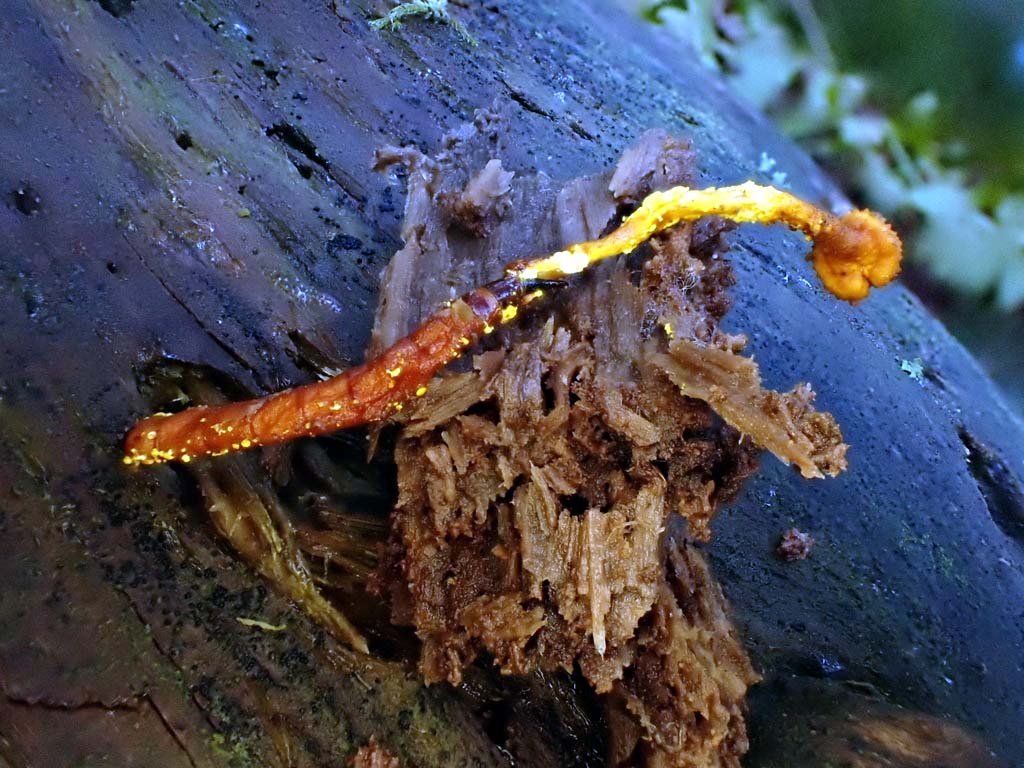
© Steve Trudell
Danny’s DNA Discoveries – Hypocreales of the PNW
by Danny Miller
|
|
Danny’s DNA Discoveries – Hypocreales of the PNW
|
|
Introduction
The Sordariomycetes, sometimes known as flask fungi, make their asci inside little volcanos called perithecia, placed around the fertile surface like a bunch of pimples. The spaces between the perithecia are sterile. In a way, these fungi may be sacrificing quantity for quality, as the spores might be more forcibly ejected out the openings of the "volcanos" and travel further. The asexual stage of fungi do not have asci (asci are a sexual structure) and therefore if you find a Sordariomycete species in the asexual stage, it will not be pimpled, but you can often tell the sexual stage of a Sordariomycete by the pimpled surface. This page covers the large order Hypocreales. Try here first for clubs and crusts covered in pimples in their sexual stage that are not black and carbonaceous (those are usually in the Xylariales). For the asexual stage without pimples, recognizing them is going to be more difficult, but try here first for clubs that don't grow on the ground, but instead on wood, other mushrooms, or insects. Also try here first for crusts that don't grow on wood, but instead on other mushrooms and insects. Nowhere is the problem of sexual and asexual forms of a mushroom more complex than on this page, so here is where I will explain it. The asexually reproductive fruitbody (anamorph) and the sexually reproductive fruitbody (teleomorph) of the same species can sometime be unrecognizably different. This page has a good many of them. In fact, many of these mushrooms were given two names in two different genera, until DNA showed us how they paired up. So now that we only want one name to win out, which is it? Typically the teleomorph name wins out, even if the anamorph name is older, so that is the name I will use below, but exceptions have been made. Trichoderma may win out against Hypocrea. abundant common uncommon rare - colour codes match my Pictorial Key and are my opinions and probably reflect my bias of living in W WA. Rare species may be locally common in certain places at certain times. |
|
Hypocreales
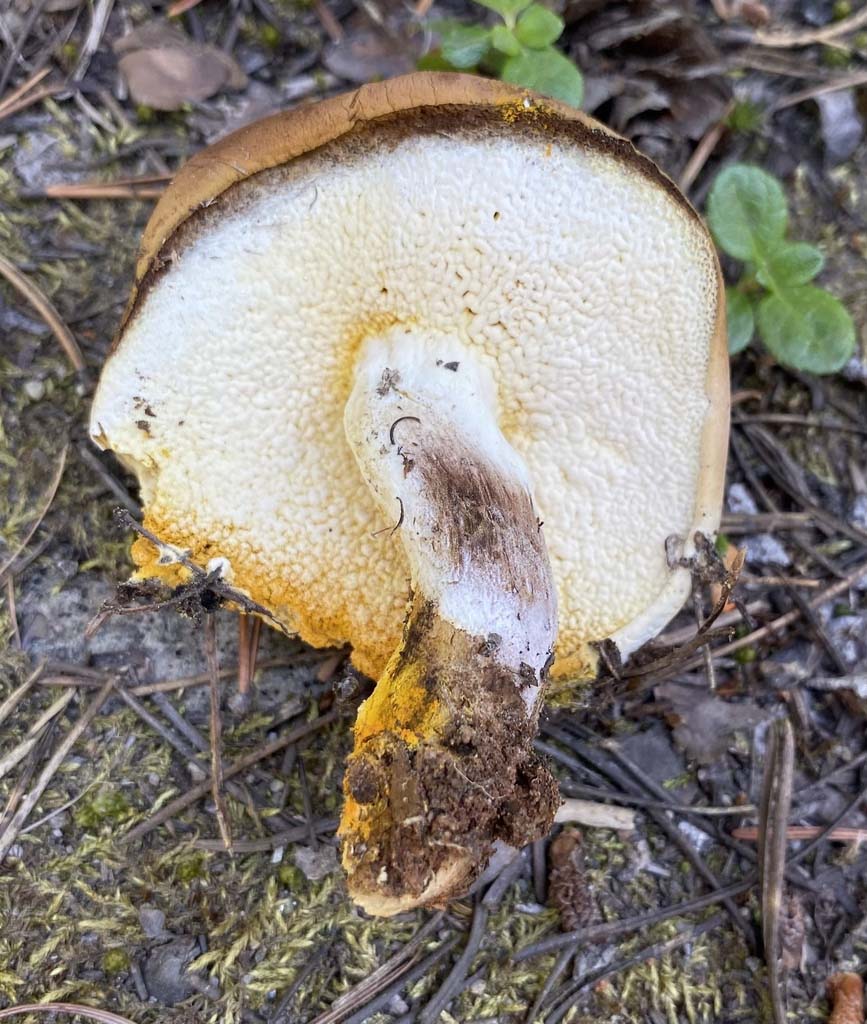
Hypomyces lactifluorum NC - lobster mushroom. A hard, orange pimpled crust completely covers a parasitized Russula subgenus brevipes. Unlike most molds, this improves the taste and texture of the food it grows on, making the Russula tastier and even more crunchy. An asexual stage has not been found. Local sequences match ENA sequences. Hypomyces sp. 'luteovirens-PNW02' - a hard, green to yellow-green lobster on Russula and Lactarius, with the pimpled green surface covering at least the gills. There are a number of species in this complex around the world. Hypomyces sp. 'luteovirens-PNW04' - another species in this complex. This one is only known from 1 WA collection. Hypomyces sp. 'AK01' - another species in the luteovirens complex. Found in AK and also in BC in 1966. Hypomyces ochraceus EU (=Hypomyces armeniacus EU) - a cottony white mold all over Russula and Lactarius (asexual). The sexual stage is rare and is a pale orange pimpled crust that forms after the mushroom is mostly dessicated (not as bright or well formed as the lobster mushroom). One WA sequence matches EU sequences of both species. Hypomyces sp. 'CA04' (Hypomyces lateritius EU misapplied) - occasionally a white cottony mold (like H. ochraceus but usually only on the gills) on Lactarius section Deliciosi (asexual), but more commonly a hard off-white pimpled crust on said gills (sexual). We do not have EU type area DNA of H. lateritius, but east coast collections purporting to be that species have quite different sequences than ours, so I'm assuming our west coast species might need a new name.
unsequenced Hypomyces lactifluorum (sexual) © Steve Trudell, H. sp. 'luteovirens-PNW04' © Yi-Min Wang, H. sp. 'luteovirens-PNW02' (sexual) and H. ochraceus (asexual) © NAMA and the Field Museum of Natural History, unsequenced H. cf lateritius (sexual) © Michael Beug
Hypomyces sp. 'chrysospermus-PNW01' - a white mold usually on boletes (or gilled Boletales) eventually turning yellow-orange. This is the asexual stage. Rarely you'll see the red sexual stage with pimples. There are 2 competing concepts in the EU for this, and this matches the most common one. The other possibility is PNW03. Hypomyces sp. 'chrysospermus-PNW03' - the minority of EU sequences match this, sequenced from ID and the CA coast. Either this or PNW01 is the real thing. Hypomyces microspermus MA - similar and sister to H. chrysospermus, differentiated microscopically by smaller spores in both stages. This is the teleomorph (sexual) name, but it has an older anamorph (asexual) name from the EU. Matching sequences are found in ENA and the EU, showing us what this probably is. Hypomyces sp. 'microspermus-PNW05' - usually only 2 bp or so different from H. microspermus, but it does clade by itself so I'm considering it separate just in case. Hypomyces sp. 'KMS-01' - one OR collection seems to indicate this species is white to bright orange on boletes. Hypomyces cervinigenus WA - an asexual white or pink cottony mold on Helvella. The sexual stage is rare. We have several PNW sequences. Hypomyces hyalinus NC - a pimpled white mold on aborted Amanitas (sexual). No known asexual stage. We have an IN sequence that may represent this, but no local DNA yet.
Hypomyces sp. 'chrysospermus-PNW03' (asexual) © Ed Barge, H. sp. 'KMS-01' © Kyla Schmitt
H. cervinigenus (asexual) © NAMA and the Field Museum of Natural History, unsequenced H. hyalinus © Richard Morrison
Hypomyces aurantius EU - an orange pimpled crust on polypores (sexual). I don't have a description of the asexual stage. Local sequences match EU sequences. Hypocrea americana NY/Protocrea farinosa UK - similar to H. aurantius but duller, have been reported without genetic evidence yet. Hypomyces rosellus EU or ENA - a white to pink cottony crust on polypores and many other mushrooms, with bright red pimples (sexual). The asexual stage is a rarer, delicate yellow to pink mycelium. EU, ENA, and WNA sequences all match, so even though I'm not sure what the type area is, we probably know what this is.
Hypomyces aurantius © NAMA and the Field Museum of Natural History, H. rosella (unsequenced, sexual) © Sandra Ruffner and (sequenced, asexual) © Drew Henderson
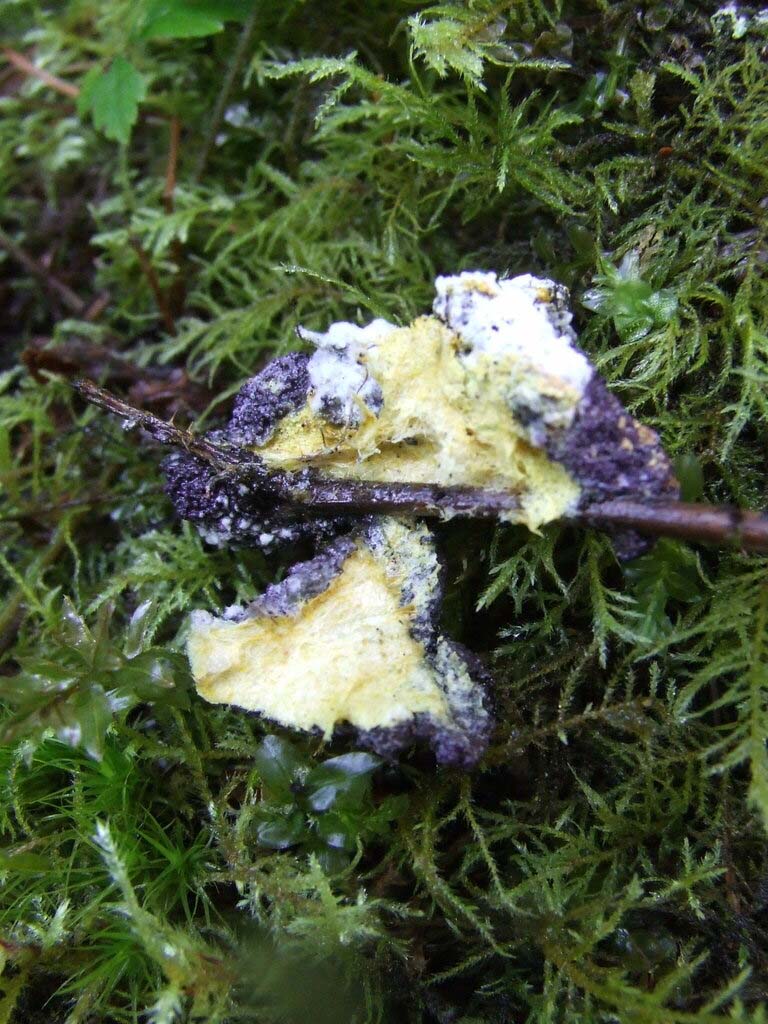
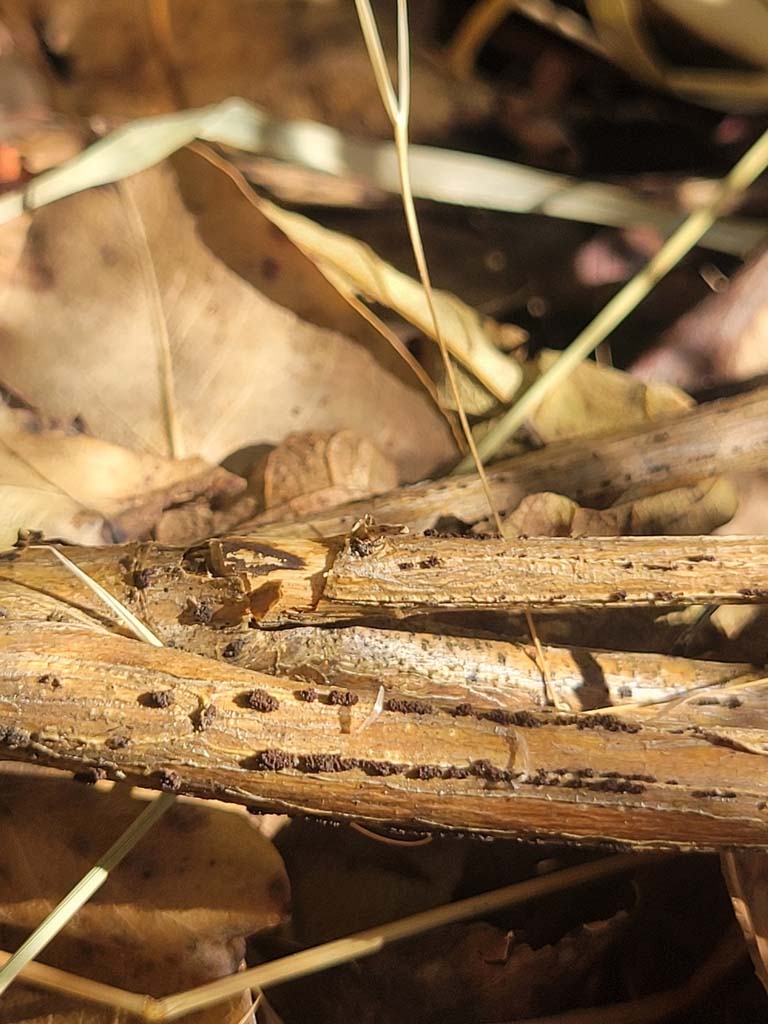
Nectria dematiosa PA - tiny red spheres on wood each with a pimple (sexual stage) or creamy pink to orange blobs (asexual). BC and CA ITS sequences are equally close to the epitype sequence of this and to the older species Nectria cinnabarina EU. A study showed that multiple genes can distinguish them where ITS can't, that there are microscopic differences that seem to indicate that at least some of our collections may be N. dematiosa, and N. dematiosa is the only species of the two confirmed from the west coast. Therefore we are using the newer name N. dematiosa. Nectria pithoides BC - red pimples on yellow tiny spheres on wood (sexual). No DNA yet. Many species of Nectria are reported from here, but which other ones occur has not been well studied. Neonectria magnoliae NC - much like Nectria cinnabarina, but the tiny red spheres are clustered a little differently (as shown) or perhaps as one large cluster. WA and OR collections are 3 bp different from a type sequence in ITS. Neonectria punicea EU - also bundles of tiny red spheres. One WA collection is a short ITS2 sequence with a few ambiguities, but otherwise a perfect match to many type area sequences. Nectriopsis violacea EU - tiny purple pimpled spheres (sexual) on the yellow slime mold Fuligo septica. Our sequences match the EU epitype sequence well. Neonectria (Corinectria) fuckeliana EU/Hydropisphaera/Calonectria - and other similar mushrooms have been reported without genetic evidence yet. Fusarium sp. 'lateritium-PNW01' - this are either black, pimply lumps on canes, or a parasite growing on those lumps. This may be F. lateritium EU, but some sequences, including this one, differ mostly in one small area from other sequences. I don't know what that means. Fusicolla sp. 'BC01' - interesting patches of slimy orange blobs on Dahlia tubers, found once in BC.
Nectria cinnabarina complex (showing both asexual and sexual) © Rudy Diaz (from CA), Neonectria magnoliae © Jordan Gates, Neonectria punicea © iNaturalist user ellietrombone, Nectriopsis violacea © Heidi Hoelting, Fusarium sp. 'lateritium-PNW01' © iNaturalist user thefungiphotographer
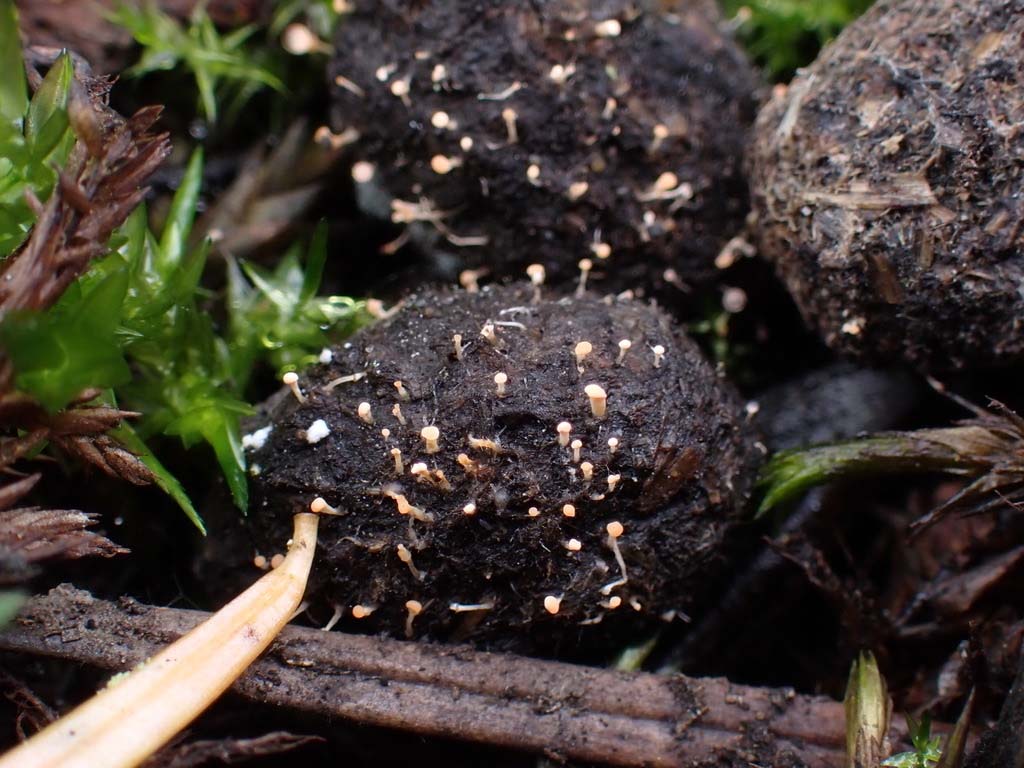
Stilbella byssiseda EU - a white spiny ball on slime molds (which could be on forest debris or wood) (asexual). The sexual pimpled stage is not known. Not known from the PNW until two BC and WA sequences matched 2 EU type area sequences. Tilachlidium brachiatum EU - long white threads growing from another mushroom. It was not known from the PNW until sequenced on a Stereum in WA, matching a bunch of EU type area sequences. Tilachlidiaceae sp. 'BC01' - the sequence of a mold discovered on moss. It's position needs to be confirmed. Sphaerostilbella sp. 'PNW01' (=Gliocladium) - white crested orange tubes growing out of decaying Stereum. One WA collection is about 2% different in ITS from Gliocladium penicillioides EU (the asexual form) and Sphaerostilbella aureonitens EU (the sexual form, thought to be a synonym). Our collection seems to be the asexual form. Emericellopsis fimetaria EU - pale orange clubs on various dung. I don't know if this is sexual or asexual.
Stilbella byssiseda © Jesse Walters, Tilachlidium brachiatum © Jack Johnson, Sphaerostilbella sp. 'PNW01' © Matthew Koons, Emericellopsis fimetaria © Matthew Koons
Epichloe typhina EU - a white to rusty pimpled crust on grasses (sexual). We have EU type area sequences and a matching sequence from WA. Note that a hybrid exists of E. typhina EU and E. festucae EU, called E. hybrida EU, with the same ITS as E. typhina, so without more genes we can't be sure which species we have. Claviceps purpurea EU - wheat ergot. It starts out as dark purple little sausage shaped sclerotia on grasses (the original source of LSD, and some blame the salem witch trial hallucinations on this species). The next year the sclerotia sprout little orange clubs with a round, pimpled head, resembling Cordyceps, rarely seen. (sexual). EU type area sequences show >1% of variation in ITS, and BC, OR and CA sequences are within that tolerance. Trichothecium crotocinigenum EU - a white asexual mold found in OR on and throughout a Genea truffle. Metapochonia suchlasporia EU -an invisible (to the naked eye) secondary fungus found on what is probably a Hirsutella parasite on an insect in OR. Calcarisporium sp. 'IN01' - this parasite aborted Pholiota terrestris in BC.
unsequenced Epichloe typhina © Jamie Axall (2 images), Claviceps purpurea (from CA) © iNaturalist user crothfels, Trichothecium crotocinigenum © Heather Dawson, Calcarisporium sp. 'IN01' (on Pholiota) © Luke Mikler
Nectriopsis tubariicola UK (on Tubaria)/Hypocrea latizonata (on Cyathus) OH/Hypocrea sulphurea PA (yellow on Exidia)/Hypomyces stephanomatis NC (on Humaria)/Hypomyces leotiicola NC (on Leotia) - unless the colour is otherwise specified, these are other white molds parasitizing other mushrooms that are reported from here without genetic evidence yet. Cosmospora berkeleyana EU - an almost invisibly small red dot parasite on Hypoxylon-like species in the Xylariales. We do have DNA from WA that falls within the 4% range of ITS found in EU sequences. This species may be too small to merit covering here.
Hypocrea is the sexual stage name and Trichoderma is the asexual stage name. Typically, as explained in the introduction, the sexual stage name would win out, but Trichoderma has been in such common usage that it may win out this time. Ironically, the species covered here are usually found in their sexual stage. Cushion-shaped Trichoderma/Hypocrea Trichoderma viride group EU - (asexual) circular green mold on wood or other mushrooms. The mold is originally white and turns green when the asexual spores mature, although touching the white mold can release the spores and make it appear to turn green. They say you can't distinguish species in this group by ITS, so I am using the oldest name for our collections until they can all be properly identified. Some species in this group are responsible for the green mold on onions. The sexual stage, not yet reported from here, are reddish pimpled cushions. Trichoderma citrinoviride ON - a similar green asexual mold, sequenced once from OR. The sexual stage has been found in CA, and are variably coloured dark pimpled cushions (green, orange, red, or black). Trichoderma pulvinatum EU - (sexual) yellowish cushion shaped pimpled blobs on polypores. A BC sequence matches many EU type area sequences. Trichoderma sp. 'WA01' - (sexual) orange pimpled cushions on wood. Trichoderma rhododendri EU - a somewhat amorphous mass of reddish-orange cushions found once on the cut end of a fir in WA. Trichoderma strictipile PQ (=Hypocrea strictipilosa)/T. lixii Papua New Guinea - and other similar species have also been reported without genetic evidence. Club-shaped Trichoderma/Hypocrea Trichoderma alutaceum EU - thick white clubs with irregular yellow heads on wood or debris. The heads don't need to be that irregular, just not perfectly rounded, to be this species. The pimples are hard to see (sexual). An OR and WA sequence match the type sequence fairly closely. Trichoderma leucopus EU - like T. alutaceum but with a regular club-shaped head. We have three WA sequences matching the EU type. Trichoderma sp. 'leucopus-CA01' - a lookalike found twice in WA. Trichoderma sp. 'PNW01' - with a regular head like T. leucopus, but perhaps more highly pigmented, according to our single collection from BC.
Trichoderma viride group © Bitty Roy, T. pulvinata © Kahsennaroroks Deom, T. sp. 'WA01' © Matthew Koons, T. rhododendri © Matthew Koons
Trichoderma alutacea © Danny Miller, T. leucopus © Graham Steinruck, T. sp. 'leucopus-CA01' © Amy Honan, T. sp. 'PNW01' © Connor Dooley
Tolypocladium (Elaphocordyceps) sp. 'capitatum-PNW01' - a reddish brown round head on a yellow club, growing from Elaphomyces deer truffles. This is a species complex around the world, so we need EU type area sequences to know which species is the real one. We do have 2 species in the PNW. Tolypocladium sp. 'capitatum-PNW02' - differs by >5% in ITS from PNW01. I don't know how to tell them apart. Tolypocladium ophioglossoides EU -an orange elongated head that turns black on a yellow club, with yellow rhizomorphs at the base, growing on Elaphomyces deer truffles. We have some EU sequences and a WA sequence that matches. Tolypocladium inflatum EU -an odd shape, like a pile of white cotton with yellow nipples, on beetle larvae and other hosts. I believe this is the sexual stage and the asexual stage is a white mold on soil. This is the original source of cyclosporine, the immuno-suppresor. One sequence for WA (and one from OR) match many EU sequences. Tolypocladium sp. 'WV01' (=Tolypocladium rouxii EU?) - a dark grey round head and dark grey upper stipe, growing from Elaphomyces. This may be T. rouxii EU.
Tolypocladium sp. 'capitatum-PNW01' © Reid Olsen, T. sp. 'capitatum-PNW02' © Sadie Hickey, unsequenced T. ophioglossoides © Connor Dooley, T. inflatum © Matthew Koons, T. sp. 'WV01' © Bryce Edward Englehardt
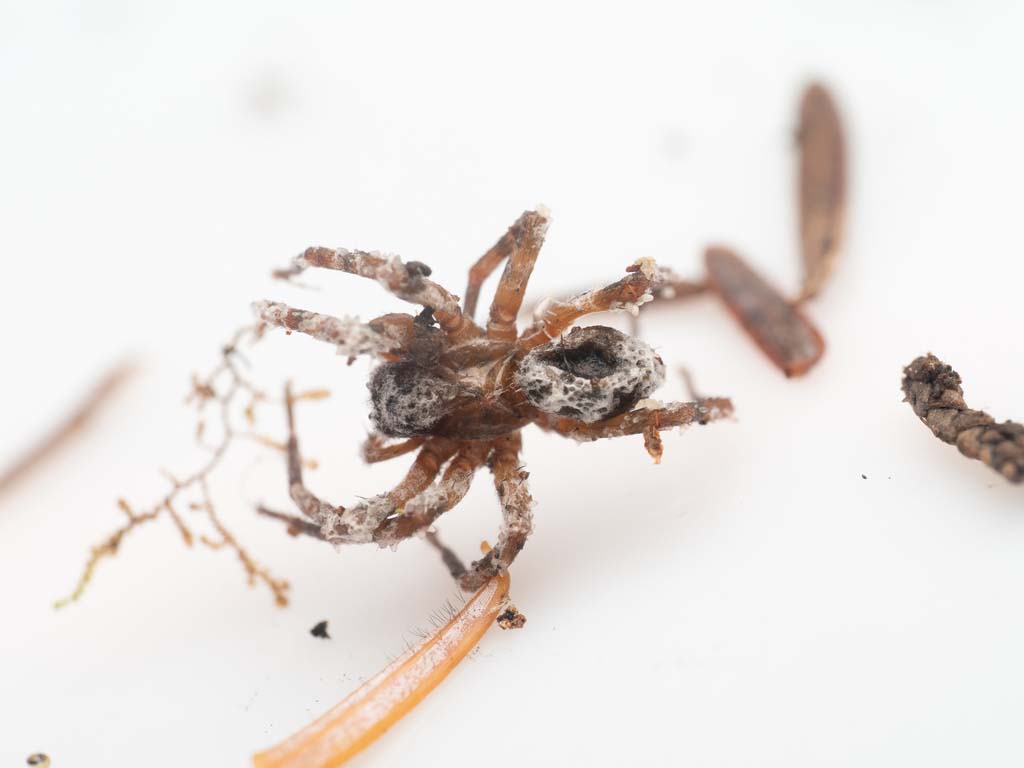
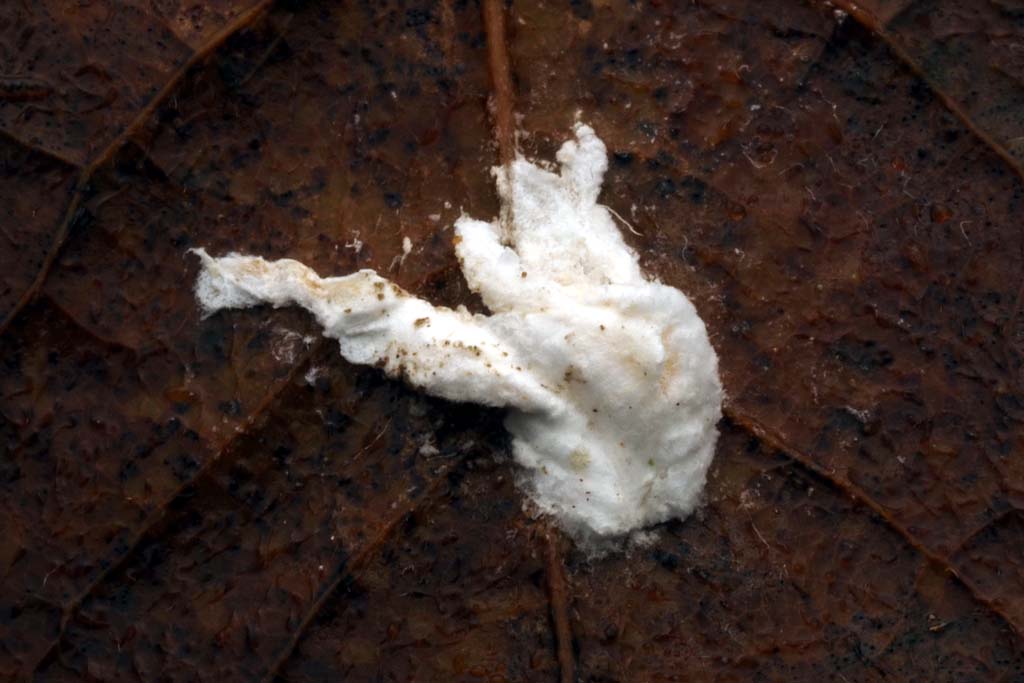
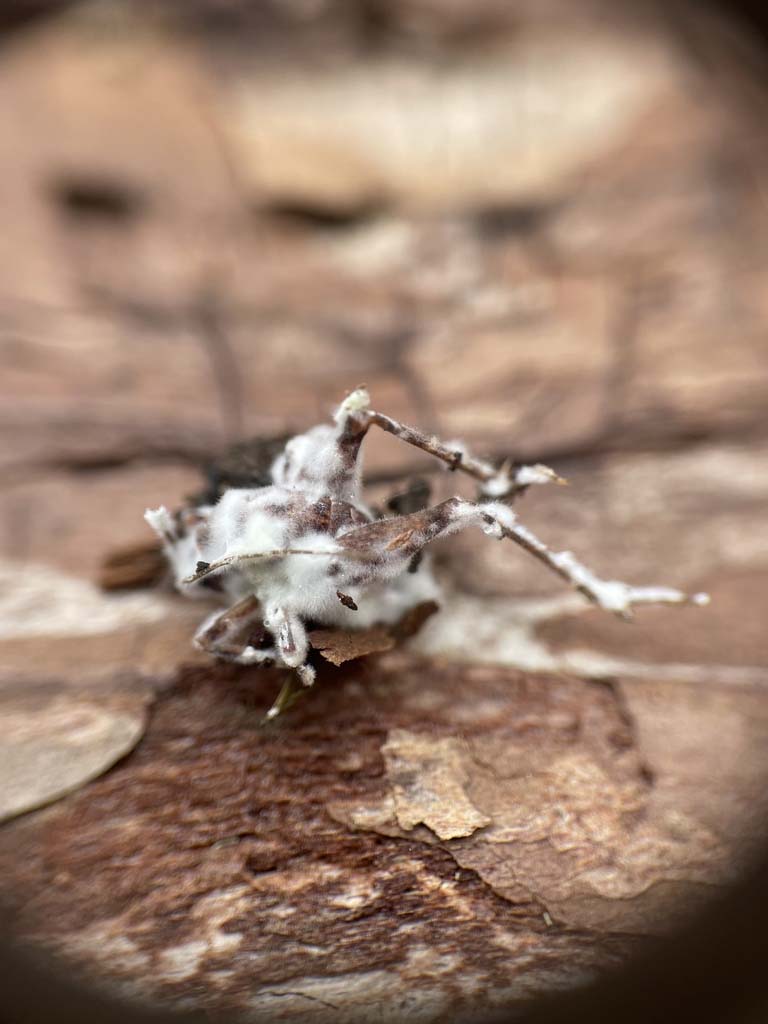
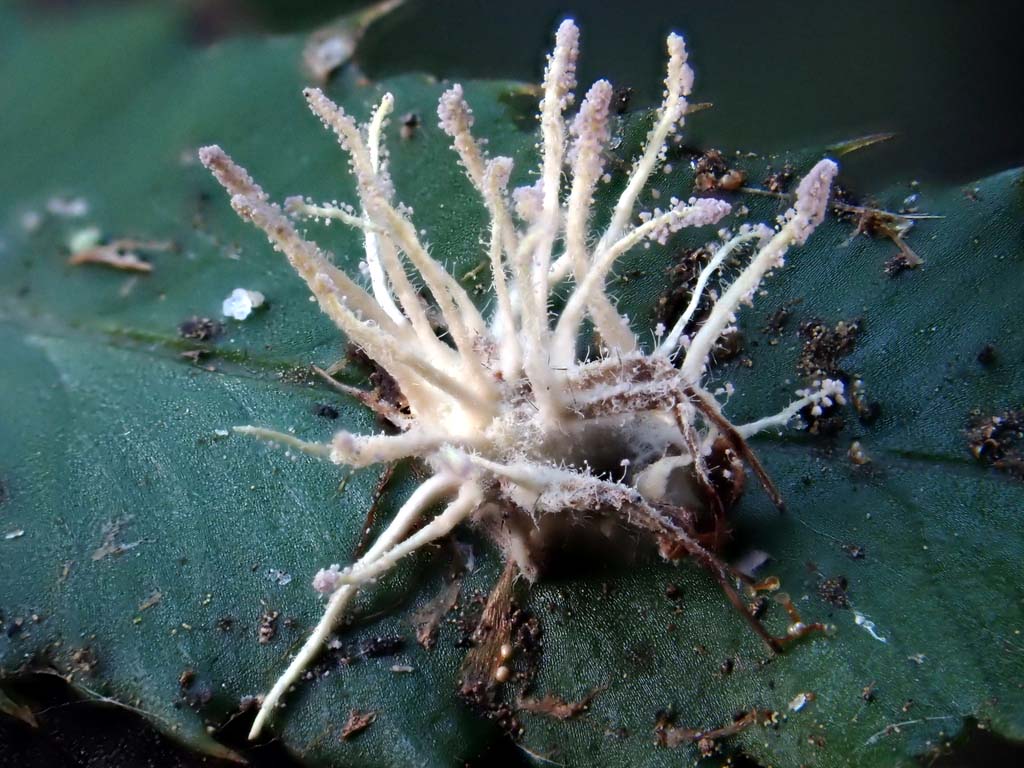
Insect parasites - besides Tolypocladium inflatum, above, several genera, including the famous Cordyceps, parasitize insects. You might have heard stories of Cordyceps infecting ants and taking over their brains to make them act in a way that helps disperse their spores. The zombie show "The Last of Us" is based on the concept of a species of Cordyceps learning to do that to humans. Asexual Akanthomyces cf.aculeatus EU - attacks/kills moths and covers them with a white mold with spikes. Found in caves. Asexual. We have conflicting sequences purporting to be this, none from the type area. We need a type sequence and local collections. Arachnidicola sp. 'CA01' (Akanthomyces s.l.) - a white mold on spiders, moved from Akanthomyces which was split. Lecanicillium muscarium UK - a white mold that was probably completely covering an insect, also moved from Akanthomyces. Beauveria bassiana EU - a white cottony mold on various insects. Asexual. This species is cultivated to create insect pesticides. We have the EU type sequence, but only one matching collection so far, from OR. The rest of the sequences turned out to be B. pseudobassiana, the east coast species. Beauveria pseudobassiana VA - this newer species can be mistaken for B. bassiana and most of our collections match the VA type. Only one turned out to be B. bassiana. Beauveria brongniartii Algeria - an irregularly shaped white mold on various insects. Asexual. We have an OR collection matching the type sequence. Samsoniella sp. 'PNW01' - This asexual beautiful fungus are orange clubs growing out of insects with the heads of the orange clubs covered in white mold. This is often mistakenly called Cordyceps farinosa, but it isn't. I'm not sure what species this is, because multiple species in this genus have the same ITS, including the oldest type species, Samsoniella inthanonensis EU. I think more than ITS will be required to figure out which species this is, unless they are all synonymized. Cordyceps (Isaria) farinosa EU - similar, but the branches seem sparser and thinner in our two local collections. We have an epitype sequence (that doesn't match most sequences with this name). We have one matching OR sequence. Engyodontium sp. 'aranearum-PNW01' - matching one of the possible concepts of this EU species, this was a cottony mold completely covering a spider in the Seattle underground tour. Gibellula sp. 'CA03' - covers every part of a spider in a white powder. Torrubiella is the sexual name.
unsequenced Akanthomyces aculeatus © Danny Miller, Arachnidicola sp. 'CA01' © Justin Chan, Lecanicillium muscarium © John D. Reynolds
Beauveria bassiana © Heather Dawson, B. pseudobassiana © Matthew Koons, B. brongniartii © iNaturalist user stellar_viscera Samsoniella sp. 'PNW01' © Matthew Koons (2 images), Cordyceps farinosa © Connor Dooley and Matthew Koons, Engyodontium sp. 'aranearum-PNW01' © Matthew Koons
Gibellula sp. 'CA03' © Matthew Koons
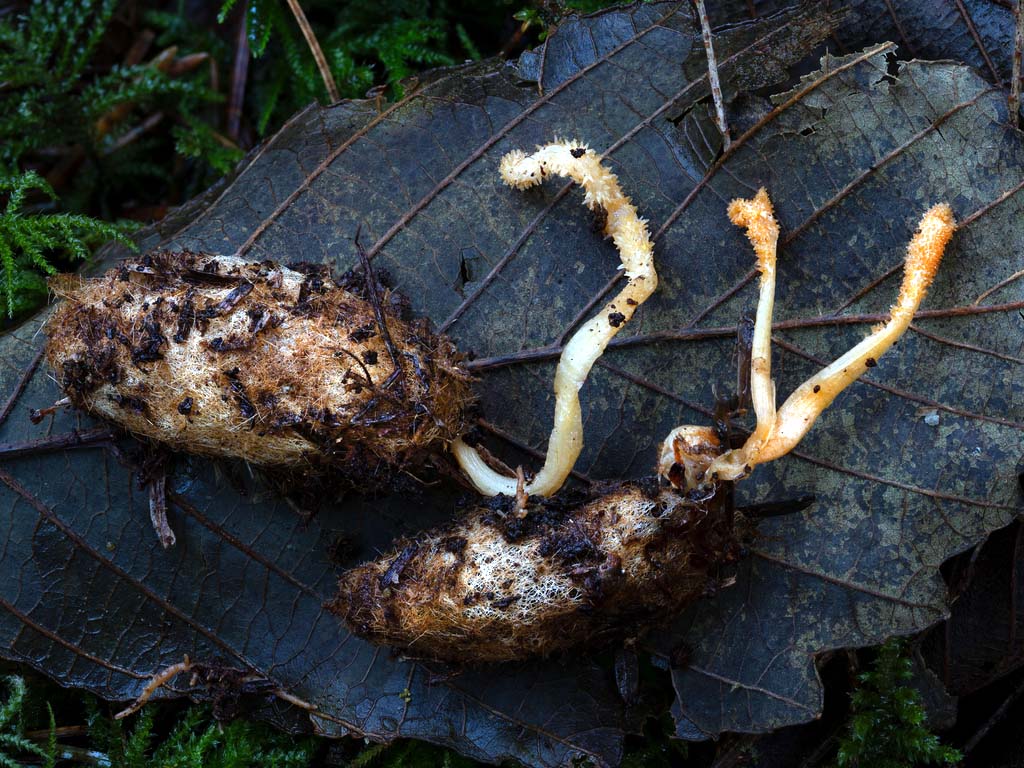
Sexual Cordyceps bifusispora EU - yellow pimpled clubs with an elongated head growing out of insects. Two WA sequences match EU sequences within 1/2-1%. Cordyceps washingtonensis WA - similar, with smaller spores. No DNA yet, but it's interesting that C. bifusispora was not known from the PNW until fruitbodies matching the description of C. washingtonensis were sequenced and turned out to be C. bifusispora. The relationship between these two species needs to be worked out. Cordyceps californica np - yellow-orange pimpled clubs with an elongated head growing out of caterpillars and larval cocoons. BC and OR sequences matches CA collections of this soon to be described species. Cordyceps sp. 'militaris-PNW02' (=Cordyceps militaris EU?) - there are other orange species on insects in the C. militaris complex here. One species is found in AK and OR, and could be the real thing, as it is also found in Europe, the type area, but other species could also be the real thing, so I am giving ours a code for now.
Cordyceps bifusispora © Connor Dooley (2 images), C. californica n.p. © Bill Weir and Kem Luther
Cordyceps sp. 'militaris-PNW02' © Noah Siegel (from AK) and James Conway (from OR)
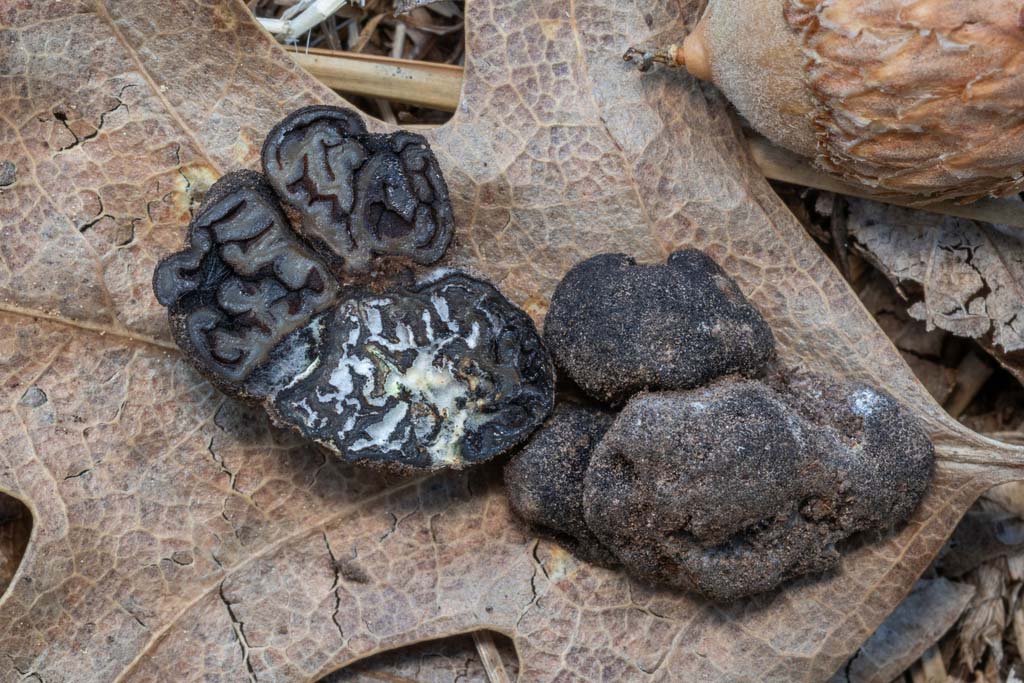
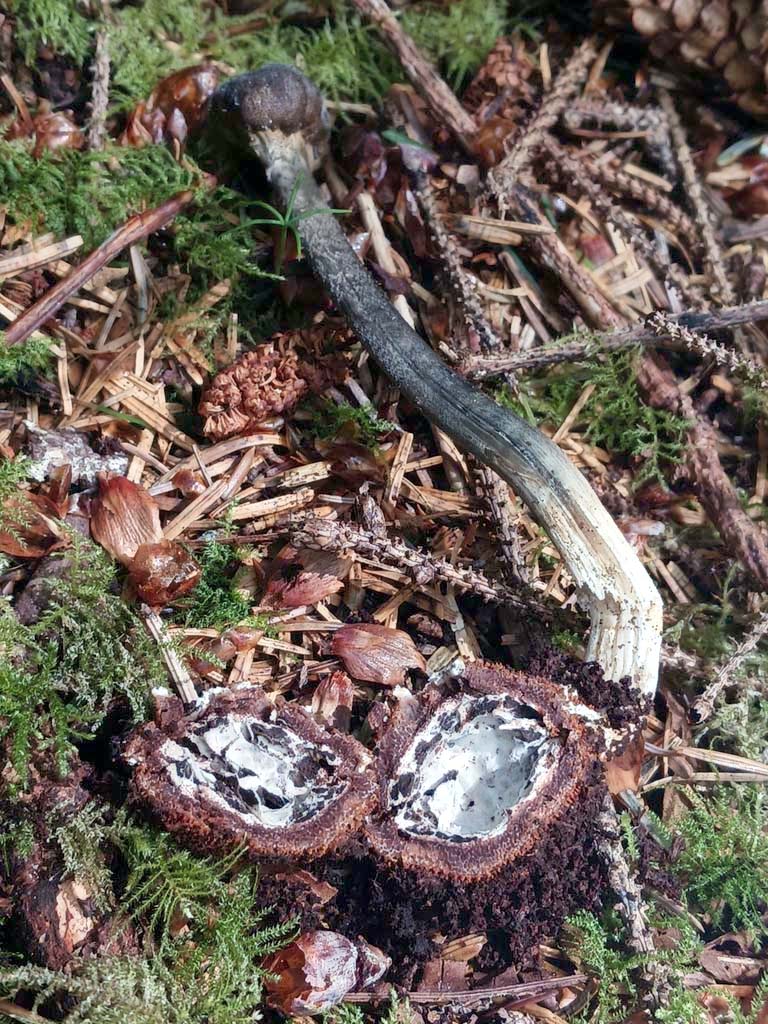
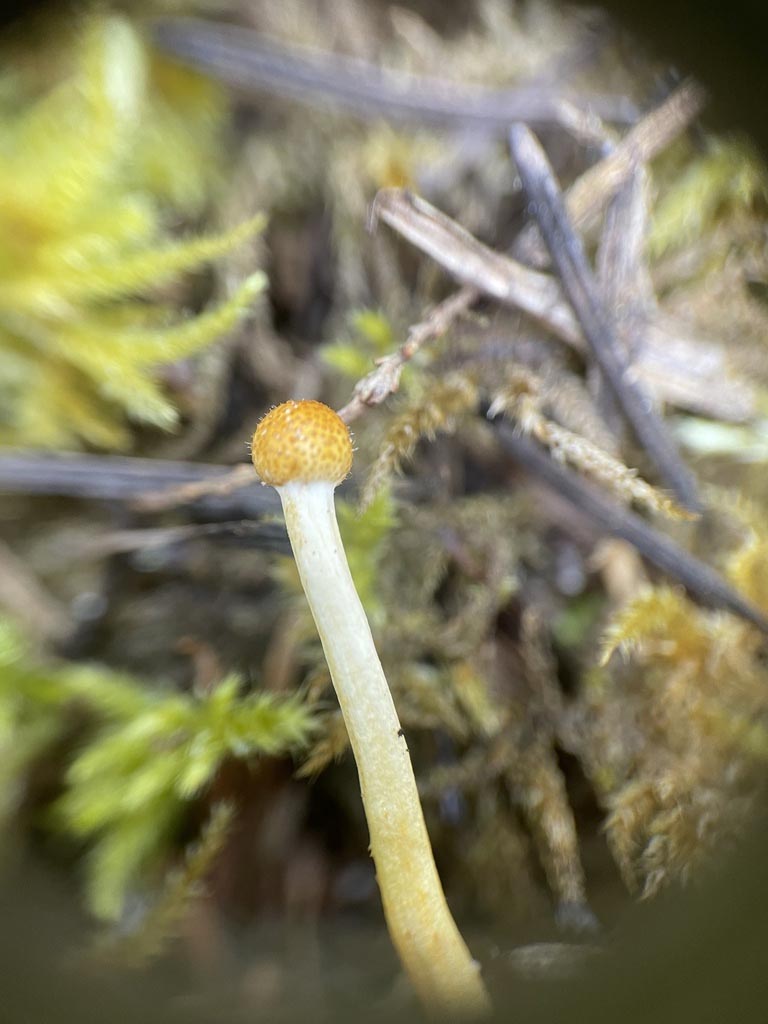
Paraisaria is sister to Ophiocordyceps according to those who described it and was split it into its own genus on slight microscopic grounds (a globose fertile terminal portion of the stroma with immersed perithecia), but that may not have been the best idea as unless we treat Ophiocordyceps and Paraisaria as one genus, further splitting may be needed. Also, we don't know for sure the location of the type species, Ophiocordyceps blattae. Paraisaria cascadensis WA (Paraisaria gracilis UK misapplied) -an orange-brown round pimpled head on a slender yellow stem, growing on Cyphoderris monstrosa grig insects. The photo is the type collection. So far, all reports of P. gracilis (found on caterpillars) have turned out to be P. cascadensis, but if you find one not on a grig insect, save it. Paraisaria sp. 'CA01' - similar, probably on caterpillars 'Ophiocordyceps' sp. 'myrmecophila-PNW02' - a similar orange-brown round pimpled head with a similar slender yellowish stem, growing on ants. This species and others in the complex need a new genus name, Neocordyceps. 'Ophiocordyceps' ravenellii SC - we have no ITS sequences, but other genes suggest that an OR collection matches the sequence of a VA collection, and that this species is here. 'Ophiocordyceps' sp. 'ravenelii-PNW01' - a sister species, a simple dark brown pimpled club, perhaps tapering to a point, growing from beetle larvae. I don't have any ITS DNA from anywhere, but we have reason to believe we also have this sister species, more common than the real thing, found so far in Oregon. This will get a name soon. 'Ophiocordyceps' cf variabilis ENA - an orange-yellow club with cauliflower-like pimpled areas near the top, growing from insect larvae. I can't find any reliable ITS DNA for this species, but other genes show it likely needs a new genus sister to Paraisaria. More work is needed to see if our PNW species is indeed 'O.' variabilis or a sister species. 'Ophiocordyceps' sp. 'PNW02' - no ITS DNA, but other genes show we have a new species found in Oregon that will get a name soon. 'Ophiocordyceps' sp. 'nutans-PNW03' - no ITS DNA, but other genes suggest a species resembling the Japanese species O. nutans was found in Oregon. Ophiocordyceps sp. 'circulionum-PNW04' - no ITS DNA, but other genes suggest a species resembling the (perhaps EU?) species O. circulionum was found in Oregon. 'Ophiocordyceps' sp. 'IN01' - found in WA. More genes need to be sequenced to ensure it belongs in Ophiocordyceps, it may not.
Paraisaria cascadensis © Connor Dooley (2 images), Paraisaria sp. 'CA01' © Heather Dawson, 'Ophiocordyceps' sp. 'myrmecophila-PNW02' © Jay Eh
unsequenced O. ravenelii © Connor Dooley, unsequenced 'Ophiocordyceps' cf variabilis © Connor Dooley, 'Ophiocordyceps' sp. 'IN01' © Matthew Koons |